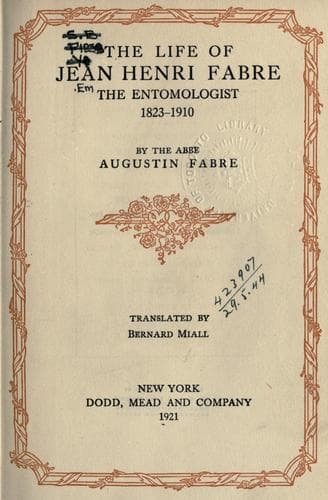
The life of Jean Henri Fabre, the entomologist, 1823-1910Fabre, Augustin
Science
The life of Jean Henri Fabre, the entomologist, 1823-1910
Fabre, Augustin
Entomologists -- France -- Biography; Fabre, Jean-Henri, 1823-1915
To show him my cellar! My private cellar! And I, poor wretch, but a
while ago, with my preposterous professor’s salary, could not even
permit myself the expense of a drop of wine, so that I used to make
myself a sort of rough cider, by placing a jar, to ferment, a
handful of brown sugar and some grated apples! My cellar! Show him
my cellar! Why not my tuns of wine, my dusty bottles, labelled
according to age and vintage! My cellar!
Completely confused, I tried to evade his request, to change the
subject. But he was tenacious.
“Show me your cellar, I beg you.”
There was no possibility of resisting such insistence.
With my finger I pointed to a corner of the kitchen where there was
a chair without a seat, and on the chair a demijohn holding a
couple of gallons.
“There’s my cellar, monsieur!”
“Your cellar? That?”
“I have no other.”
“That’s all?”
“Alas, yes. That’s all!”
“Ah!”
“Not a word more from the scientist. Pasteur, it was easy to see,
knew nothing of those highly-flavoured dishes which the common
people call la vache enragée. If my cellar, that is the old chair
and the hollow-sounding demijohn, had nothing to tell concerning
the ferments to be fought by means of heat, it spoke very
eloquently of another subject, which my illustrious visitor did not
appear to understand. One microbe evaded him, and it was one of the
most terrible; the microbe of misfortune strangling good will.”
[75]
It is told of one of our most famous dramatists who, like Fabre, is a
self-made man, having raised himself by persistent effort from the
workshop to the Academy, that when he was struggling against the
difficulties of the first steps upward, he had also to contend against
the impassive coldness of eminent colleagues from whom he might have
expected some support. “Young man,” said one of these—and he was not
one of the least illustrious—“young man, la vache enragée is excellent;
to help you would be to spoil you.”
No doubt the vache enragée, like the method d’ignorance, may have its
virtues. The story of Fabre’s career, and of Brieux’, goes to prove as
much. But of this sort of discipline, like that which extols the
advantages of ignorance, we may remark that one may have too much of
it; that it succeeds only on condition of being applied with moderation
and discretion.
A robust child of the Rouergat peasantry, such as Fabre, is capable of
enduring an abnormal dose with unusual results. But under too great
strain steel of the toughest temper is in danger of being broken or
fatigued. In hours of difficulty and suffering, if they are unduly
prolonged, the most resolute and courageous feel the need of an
encouraging voice, and a hand outstretched to give the moral or even
the material help with which one cannot always dispense with impunity.
Public-domain text, read in full here on John Shaqi.
Reviews
Reviews
No reviews yet
Be the first to share your thoughts on this work.
Elsewhere in the archive
Join the Discussion
Join the discussion
Sign in to leave a comment or review.
Sign InorCreate an account