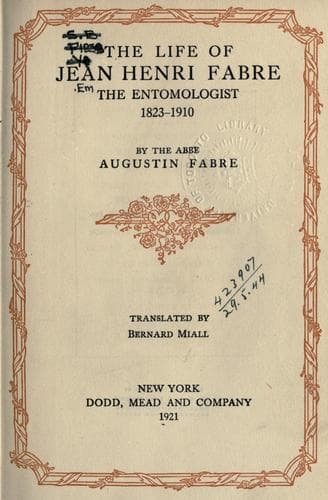
The life of Jean Henri Fabre, the entomologist, 1823-1910Fabre, Augustin
Science
The life of Jean Henri Fabre, the entomologist, 1823-1910
Fabre, Augustin
Entomologists -- France -- Biography; Fabre, Jean-Henri, 1823-1915
The reception came to an end, bows were exchanged, and we were
dismissed. A luncheon awaited us at the minister’s house. I sat on
his right, not a little embarrassed by the privilege: on his left
was a physiologist of great renown. Like the others, I spoke of all
manner of things, including even Avignon Bridge. Duruy’s son,
sitting opposite me, chaffed me pleasantly about the famous bridge
on which everybody dances; [77] he smiled at my impatience to get
back to the thyme-scented hills and the grey olive-yards rich in
Grasshoppers.
“What!” said his father. “Won’t you visit our museums, our
collections? There are some very interesting things there.”
“I know, Monsieur le Ministre, but I shall find better things,
things more to my taste, in the incomparable museum of the fields.”
“Then what do you propose to do?”
“I propose to go back to-morrow.”
I did go back, I had had enough of Paris: never had I felt such
tortures of loneliness as in that immense whirl of humanity. To get
away, to get away was my one idea. [78]
In re-reading this curious and attractive episode of Fabre’s career,
our mind was haunted by the no less attractive memory of another
illustrious son of our Aveyron, which shares his glory with Provence.
[79]
Like the author of the Souvenirs entomologiques, the writer of the
Poésie des Bêtes is the son of humble Aveyron peasants, who raised
himself by his own efforts from the first to the second grade of school
teachers, and whose genius, like that of Fabre, faithful to the
environment in which he was born, confines itself, with jealous care,
like that of the naturalist, to the “incomparable museum of the
fields,” which he describes with the same clearness of vision and the
same sincerity of feeling.
Like Fabre, Fabié is a modest man, who does not readily emerge from the
obscurity in which his native timidity delights. In his case again it
needed the perspicacity and kindliness of Duruy, “the champion of the
modest and the laborious,” to single him out and drag him out of his
hole; just as, at the present time, a Parisian publicist, of whom his
fine talents have made a conquest, has truly remarked, it needed the
energetic intervention of his friends to give his poetic genius the
supreme consecration reserved for the works of our most eminent
writers: “Thank heaven, the author of the Poésie des Bêtes and Bonne
Terre has friends who admire the poet as greatly as they esteem the
man, and if M. François Fabié cannot make up his mind to emerge from
the obscurity in which he has only too long, indeed always, enveloped
himself, I venture to hope that they will not hesitate to take him by
the shoulders and bring him out into the broad light of day, and that
they will then propel him willy-nilly across the Pont des Arts at the
end of which rises the dome of the illustrious Forty.” [80]
Public-domain text, read in full here on John Shaqi.
Reviews
Reviews
No reviews yet
Be the first to share your thoughts on this work.
Elsewhere in the archive
Join the Discussion
Join the discussion
Sign in to leave a comment or review.
Sign InorCreate an account