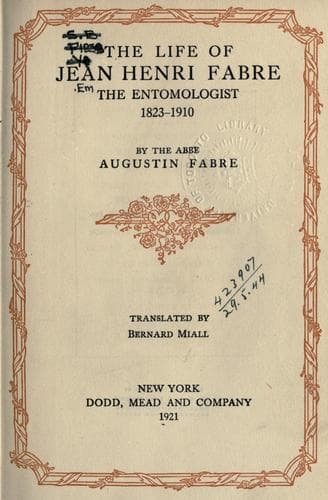
The life of Jean Henri Fabre, the entomologist, 1823-1910Fabre, Augustin
Science
The life of Jean Henri Fabre, the entomologist, 1823-1910
Fabre, Augustin
Entomologists -- France -- Biography; Fabre, Jean-Henri, 1823-1915
One might say the same of Fabre. Some one should have taken him, too,
by the shoulders and pushed him forcibly across the Pont des Arts, and
should then have kept his eyes upon him until he reached his
destination, lest he should turn aside and fly for the Pont d’Avignon,
for we must not forget that Duruy and his gendarmes, although they were
capable of making him come to Paris, were incapable of keeping him
there.
Fortunately Fabre’s work is not of the kind that needs, for its
survival, the factitious glitter of honours. By its own merit it
assures his name of an immortality greater than that of the Immortal
Forty.
There were three men, at this period of Fabre’s life, who contributed
not a little to kindle or revive the fires of his scientific activity.
Dufour’s essays furnished the spark that made the inward flame burst
into a magnificent blaze of light. Experience and the example of
Pasteur added fuel to the fire, by teaching him to keep as far as
possible in close contact with nature. Duruy’s good will brought to
this blaze the vivifying breath without which all ardour becomes
chilled and all light extinguished.
But genius does not merely develop under the impulse of the inner life,
and the influence of the external life, which in some men is more
potent and more active; it is determined also by the pressure of
events, of which the most painful are not always the least effectual.
Who does not know that famous line of Musset’s, which has almost become
a proverb:
“L’homme est un apprenti, la douleur est son maître.”
(Man’s an apprentice, and his master, sorrow.)
Like so many others, Fabre learned this by cruel yet fortunate
experience. He had to suffer poverty, lack of success, and persecution,
yet these were to him so many stepping-stones by which he rose to the
serene and solitary height where his genius could at last unfurl its
wings in freedom and soar at will.
While Fabre had no ambition in respect of the Académie, he was
ambitious where the University was concerned. Absolutely careless of
titles and dignities, he was particularly eager to learn and to teach
others as widely and as completely as possible. It was not enough for
him to possess the knowledge requisite for a professor in a lycée, as
it had not been enough to qualify for a primary schoolmaster. He wanted
to attain that rare degree of knowledge which the higher education
demands; he dreamed of occupying a chair of natural history in a
faculty. Then he could free himself from the material tasks that
constituted the danger as well as the merit of the secondary
schoolmaster; he could devote himself at leisure to those wonderful
natural sciences in which he glimpsed, not only a vitality and
inspiration that appealed to his habit of mind, but a wealth of new
subjects to be treated, of rich veins to be mined.
Public-domain text, read in full here on John Shaqi.
Reviews
Reviews
No reviews yet
Be the first to share your thoughts on this work.
Elsewhere in the archive
Join the Discussion
Join the discussion
Sign in to leave a comment or review.
Sign InorCreate an account