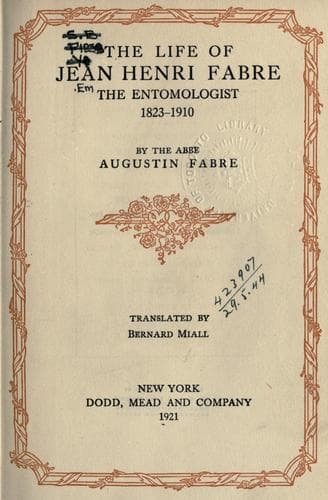
The life of Jean Henri Fabre, the entomologist, 1823-1910Fabre, Augustin
Science
The life of Jean Henri Fabre, the entomologist, 1823-1910
Fabre, Augustin
Entomologists -- France -- Biography; Fabre, Jean-Henri, 1823-1915
Hardly was the factory in full swing, when a piece of news was
bruited, at first a vague rumour, an echo of probabilities rather
than certainties, and then a positive statement leaving no room for
doubt. Chemistry had obtained the madder-dye by artificial means;
thanks to a laboratory concoction, it was utterly overthrowing the
agriculture and industries of my district. This result, while
destroying my work and my hopes, did not surprise me unduly. I
myself had toyed with the problem of artificial alizarin; and I
knew enough about it to foresee that, in no very distant future,
the product of the chemist’s retort would take the place of the
product of the fields. [83]
It was only a step from the Capitol to the Tarpeian Rock. He who but
now had discovered Peru was about to feel more keenly than ever the
sharp pangs of poverty; he whom science and fortune had lately
conspired to raise to one of the highest chairs in the University was
to be forced to descend from the modest desk of a lycée professor; he
whom the friendship and admiration of Duruy had dreamed, it is said, of
promoting to the high dignity of tutor to the Prince Imperial [84] was
now to be forbidden to teach the schoolgirls of his own Provence!
For it was about this time that “he attempted to found at Avignon a
sort of system of secondary education for young girls,” and delivered,
in the ancient abbey of Saint-Martial, those famous free lectures which
remained so celebrated in the memory of the generation of that period,
and at which an eager crowd thronged to hear him, among the most
assiduous members being Roumanille, the friend of Mistral, who knew the
exquisite secret of weaving into his melodies “the laughter of young
girls and the flowers of spring.”
For no one could explain a fact better than Fabre; no one could
elucidate it so fully and so clearly. No one could teach as he did, so
simply, so picturesquely, yet in so original a fashion.
And he had the power of communicating to his hearers his own
conviction, his profound faith, the sacred fire that inspired him, the
passion which he felt for all natural things.
But there were sufficient reasons to set the sectarians all agog and
excite the rancour of the envious, some regarding this great novelty of
placing the natural sciences within reach of young girls as a heresy
and even a scandal, others finding it unsatisfactory that this
“irregular person, the child of his own solitary studies, should fill,
by his work, his successes, and the magic of his teaching, a place so
apart and so disproportionate. Their cavilling, their underhand cabals,
their secret manœuvring won an easy triumph.” In what hateful and
tragic fashion we must let him tell us in his own words:
Public-domain text, read in full here on John Shaqi.
Reviews
Reviews
No reviews yet
Be the first to share your thoughts on this work.
Elsewhere in the archive
Join the Discussion
Join the discussion
Sign in to leave a comment or review.
Sign InorCreate an account