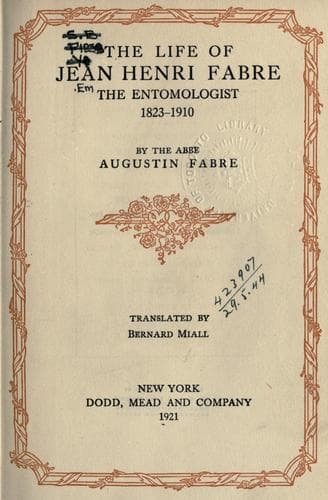
The life of Jean Henri Fabre, the entomologist, 1823-1910Fabre, Augustin
Science
The life of Jean Henri Fabre, the entomologist, 1823-1910
Fabre, Augustin
Entomologists -- France -- Biography; Fabre, Jean-Henri, 1823-1915
The first of these removals took place in 1870. A little earlier, a
minister who has left a lasting memory in the university, that fine
man Victor Duruy, [85] had instituted classes for the secondary
education of girls. This was the beginning, as far as was then
possible, of the burning question of to-day. I very gladly lent my
humble aid to this labour of light. I was put to teach physical and
natural science. I had faith, and was not sparing of work, with the
result that I rarely faced a more attentive or interested audience.
The days on which the lessons fell were red-letter days, especially
when the lesson was botany and the table disappeared from view
under the treasures of the neighbouring conservatories.
That was going too far. In fact, you can see how heinous my crime
was: I taught those young persons what air and water are; whence
the lightning comes and the thunder; by what device our thoughts
are transmitted across the seas and continents by means of a metal
wire; why fire burns and why we breathe; how a seed puts forth
shoots and how a flower blossoms: all eminently hateful things in
the eyes of some people, whose feeble eyes are dazzled by the light
of day.
The little lamp must be put out as quickly as possible and measures
taken to get rid of the officious person who strove to keep it
alight. The scheme was darkly plotted with the old maids who owned
my house and who saw the abomination of desolation in these new
educational methods. I had no written agreement to protect me. The
bailiff appeared with a notice on stamped paper. It baldly informed
me that I must move out within four weeks from date, failing which
the law would turn my goods and chattels into the street. I had
hurriedly to provide myself with a dwelling. The first house which
we found happened to be at Orange. Thus was my exodus from Avignon
effected. [86]
After this we understand why it was that Fabre cried:
“It is all over; the downfall of my hopes is complete!”
But no, beloved master! All was not over. The immortal work with which
your name is connected was as yet to be begun. This ruin, this
mortification, this grievous overthrow of all your hopes in connection
with the University were even needed to lead you back to the fields, to
enable you to raise, in all its amplitude and its exquisite
originality, the scientific edifice of which you may say, with the
ancient poet: Exegi monumentum aere perennis. [87]
M. Edmond Perrier very judiciously remarked, in his speech at Sérignan:
“In Paris, in a great city, you would have had great difficulty in
finding your beloved insects, and entomology would have lost a great
part of those magnificent observations which are the glory of French
science.”
Public-domain text, read in full here on John Shaqi.
Reviews
Reviews
No reviews yet
Be the first to share your thoughts on this work.
Elsewhere in the archive
Join the Discussion
Join the discussion
Sign in to leave a comment or review.
Sign InorCreate an account