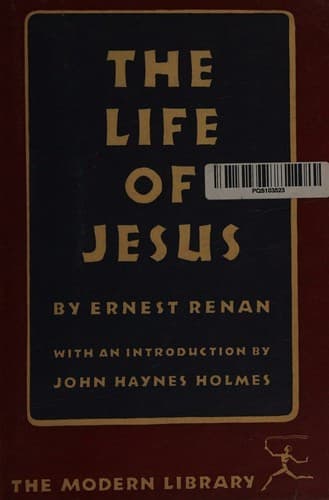
Christian biography -- Palestine; Jesus Christ -- Biography
Before his last stay, which was by far the longest of all that he made
at Jerusalem, and which was terminated by his death, Jesus endeavored,
however, to obtain a hearing. He preached; people spoke of him; and
they conversed respecting certain deeds of his which were looked upon
as miraculous. But from all that, there resulted neither an
established church at Jerusalem nor a group of Hierosolymite
disciples. The charming teacher, who forgave every one provided they
loved him, could not find much sympathy in this sanctuary of vain
disputes and obsolete sacrifices. The only result was that he formed
some valuable friendships, the advantage of which he reaped afterward.
He does not appear at that time to have made the acquaintance of the
family of Bethany, which, amidst the trials of the latter months of
his life, brought him so much consolation. But very early he attracted
the attention of a certain Nicodemus, a rich Pharisee, a member of the
Sanhedrim, and a man occupying a high position in Jerusalem.[1] This
man, who appears to have been upright and sincere, felt himself
attracted toward the young Galilean. Not wishing to compromise
himself, he came to see Jesus by night, and had a long conversation
with him.[2] He doubtless preserved a favorable impression of him, for
afterward he defended Jesus against the prejudices of his
colleagues,[3] and, at the death of Jesus, we shall find him tending
with pious care the corpse of the master.[4] Nicodemus did not become
a Christian; he had too much regard for his position to take part in a
revolutionary movement which as yet counted no men of note amongst its
adherents. But he evidently felt great friendship for Jesus, and
rendered him service, though unable to rescue him from a death which
even at this period was all but decreed.
[Footnote 1: It seems that he is referred to in the Talmud. Talm. of
Bab., _Taanith_, 20 _a_; _Gittin_, 56 _a_; _Ketuboth_, 66 _b_;
treatise _Aboth Nathan_, vii.; Midrash Rabba, _Eka_, 64 _a_. The
passage _Taanith_ identifies him with Bounai, who, according to
_Sanhedrim_ (see ante, p. 212, note 2), was a disciple of Jesus. But
if Bounai is the Banou of Josephus, this identification will not hold
good.]
[Footnote 2: John iii. 1, and following, vii. 50. We are certainly
free to believe that the exact text of the conversation is but a
creation of John's.]
[Footnote 3: John vii. 50, and following.]
[Footnote 4: John xix. 39.]
Public-domain text, read in full here on John Shaqi.
Reviews
Reviews
No reviews yet
Be the first to share your thoughts on this work.
Elsewhere in the archive
Join the Discussion
Join the discussion
Sign in to leave a comment or review.
Sign InorCreate an account