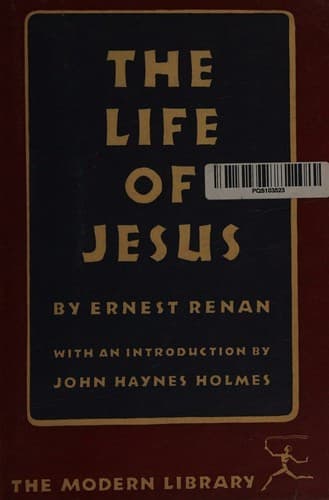
Christian biography -- Palestine; Jesus Christ -- Biography
As to the celebrated doctors of the time, Jesus does not appear to
have had any connection with them. Hillel and Shammai were dead; the
greatest authority of the time was Gamaliel, grandson of Hillel. He
was of a liberal spirit, and a man of the world, not opposed to
secular studies, and inclined to tolerance by his intercourse with
good society.[1] Unlike the very strict Pharisees, who walked veiled
or with closed eyes, he did not scruple to gaze even upon Pagan
women.[2] This, as well as his knowledge of Greek, was tolerated
because he had access to the court.[3] After the death of Jesus, he
expressed very moderate views respecting the new sect.[4] St. Paul sat
at his feet,[5] but it is not probable that Jesus ever entered his
school.
[Footnote 1: Mishnah, _Baba Metsia_, v. 8; Talm. of Bab., _Sota_, 49
_b_.]
[Footnote 2: Talm. of Jerus., _Berakoth_, ix. 2.]
[Footnote 3: Passage _Sota_, before cited, and _Baba Kama_, 83 _a_.]
[Footnote 4: _Acts_ v. 34, and following.]
[Footnote 5: _Acts_ xxii. 3.]
One idea, at least, which Jesus brought from Jerusalem, and which
henceforth appears rooted in his mind, was that there was no union
possible between him and the ancient Jewish religion. The abolition of
the sacrifices which had caused him so much disgust, the suppression
of an impious and haughty priesthood, and, in a general sense, the
abrogation of the law, appeared to him absolutely necessary. From this
time he appears no more as a Jewish reformer, but as a destroyer of
Judaism. Certain advocates of the Messianic ideas had already admitted
that the Messiah would bring a new law, which should be common to all
the earth.[1] The Essenes, who were scarcely Jews, also appear to have
been indifferent to the temple and to the Mosaic observances. But
these were only isolated or unavowed instances of boldness. Jesus was
the first who dared to say that from his time, or rather from that of
John,[2] the Law was abolished. If sometimes he used more measured
terms,[3] it was in order not to offend existing prejudices too
violently. When he was driven to extremities, he lifted the veil
entirely, and declared that the Law had no longer any force. On this
subject he used striking comparisons. "No man putteth a piece of new
cloth into an old garment, neither do men put new wine into old
bottles."[4] This was really his chief characteristic as teacher and
creator. The temple excluded all except Jews from its enclosure by
scornful announcements. Jesus had no sympathy with this. The narrow,
hard, and uncharitable Law was only made for the children of Abraham.
Jesus maintained that every well-disposed man, every man who received
and loved him, was a son of Abraham.[5] The pride of blood appeared to
him the great enemy which was to be combated. In other words, Jesus
was no longer a Jew. He was in the highest degree revolutionary; he
called all men to a worship founded solely on the fact of their being
children of God.
Public-domain text, read in full here on John Shaqi.
Reviews
Reviews
No reviews yet
Be the first to share your thoughts on this work.
Elsewhere in the archive
Join the Discussion
Join the discussion
Sign in to leave a comment or review.
Sign InorCreate an account