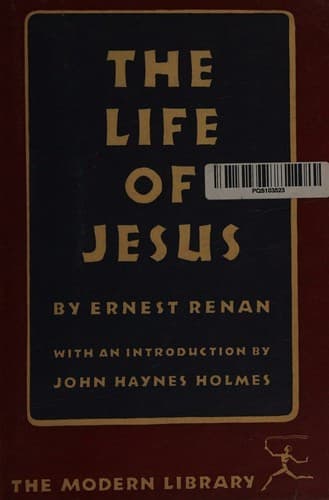
Christian biography -- Palestine; Jesus Christ -- Biography
abyss, impossible to most, which the weakness of the human faculties
has created between God and man.
[Footnote 1: The passages in support of this are too numerous to be
referred to here.]
[Footnote 2: It is only in the Gospel of John that Jesus uses the
expression "Son of God," or "Son," in speaking of himself.]
[Footnote 3: Matt. xii. 8; Luke vi. 5.]
[Footnote 4: Matt. xi. 27.]
[Footnote 5: John v. 22.]
[Footnote 6: Matt. xvii. 18, 19; Luke xvii. 6.]
[Footnote 7: Matt. ix. 8.]
[Footnote 8: Matt. ix. 2, and following; Mark ii. 5, and following;
Luke v. 20, vii. 47, 48.]
[Footnote 9: Matt. xii. 41, 42; xxii. 43, and following; John viii.
52, and following.]
We cannot mistake in these affirmations of Jesus the germ of the
doctrine which was afterward to make of him a divine hypostasis,[1] in
identifying him with the Word, or "second God,"[2] or eldest Son of
God,[3] or _Angel Metathronos_,[4] which Jewish theology created apart
from him.[5] A kind of necessity caused this theology, in order to
correct the extreme rigor of the old Monotheism, to place near God an
assessor, to whom the eternal Father is supposed to delegate the
government of the universe. The belief that certain men are
incarnations of divine faculties or "powers," was widespread; the
Samaritans possessed about the same time a thaumaturgus named Simon,
whom they identified with the "great power of God."[6] For nearly two
centuries, the speculative minds of Judaism had yielded to the
tendency to personify the divine attributes, and certain expressions
which were connected with the Divinity. Thus, the "breath of God,"
which is often referred to in the Old Testament, is considered as a
separate being, the "Holy Spirit." In the same manner the "Wisdom of
God" and the "Word of God" became distinct personages. This was the
germ of the process which has engendered the _Sephiroth_ of the
Cabbala, the _AEons_ of Gnosticism, the hypostasis of Christianity, and
all that dry mythology, consisting of personified abstractions, to
which Monotheism is obliged to resort when it wishes to pluralize the
Deity.
[Footnote 1: See especially John xiv., and following. But it is
doubtful whether we have here the authentic teaching of Jesus.]
[Footnote 2: Philo, cited in Eusebius, _Praep. Evang._, vii. 13.]
[Footnote 3: Philo, _De migr. Abraham_, Sec. 1; _Quod Deus immut._, Sec. 6;
_De confus. ling._, Sec. 9, 14 and 28; De profugis, Sec. 20; _De Somniis_,
i. Sec. 37; _De Agric. Noe_, Sec. 12; _Quis rerum divin. haeres_, Sec. 25, and
following, 48, and following, &c.]
[Footnote 4: [Greek: Metathronos], that is, sharing the throne of God;
a kind of divine secretary, keeping the register of merits and
demerits; _Bereshith Rabba_, v. 6 _c_; Talm. of Bab., _Sanhedr._, 38
_b_; _Chagigah_, 15 _a_; Targum of Jonathan, _Gen._, v. 24.]
Public-domain text, read in full here on John Shaqi.
Reviews
Reviews
No reviews yet
Be the first to share your thoughts on this work.
Elsewhere in the archive
Join the Discussion
Join the discussion
Sign in to leave a comment or review.
Sign InorCreate an account