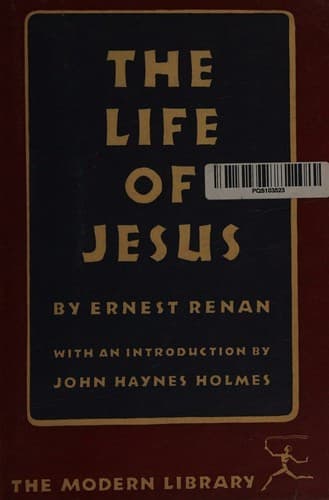
Christian biography -- Palestine; Jesus Christ -- Biography
[Footnote 5: This theory of the [Greek: Logos] contains no Greek
elements. The comparisons which have been made between it and the
_Honover_ of the Parsees are also without foundation. The _Minokhired_
or "Divine Intelligence," has much analogy with the Jewish [Greek:
Logos]. (See the fragments of the book entitled _Minokhired_ in
Spiegel, _Parsi-Grammatik_, pp. 161, 162.) But the development which
the doctrine of the _Minokhired_ has taken among the Parsees is
modern, and may imply a foreign influence. The "Divine Intelligence"
(_Maiyu-Khratu_) appears in the Zend books; but it does not there
serve as basis to a theory; it only enters into some invocations. The
comparisons which have been attempted between the Alexandrian theory
of the Word and certain points of Egyptian theology may not be
entirely without value. But nothing indicates that, in the centuries
which preceded the Christian era, Palestinian Judaism had borrowed
anything from Egypt.]
[Footnote 6: _Acts_ viii. 10.]
Jesus appears to have remained a stranger to these refinements of
theology, which were soon to fill the world with barren disputes. The
metaphysical theory of the Word, such as we find it in the writings of
his contemporary Philo, in the Chaldean Targums, and even in the book
of "Wisdom,"[1] is neither seen in the _Logia_ of Matthew, nor in
general in the synoptics, the most authentic interpreters of the words
of Jesus. The doctrine of the Word, in fact, had nothing in common
with Messianism. The "Word" of Philo, and of the Targums, is in no
sense the Messiah. It was John the Evangelist, or his school, who
afterward endeavored to prove that Jesus was the Word, and who
created, in this sense, quite a new theology, very different from that
of the "kingdom of God."[2] The essential character of the Word was
that of Creator and of Providence. Now, Jesus never pretended to have
created the world, nor to govern it. His office was to judge it, to
renovate it. The position of president at the final judgment of
humanity was the essential attribute which Jesus attached to himself,
and the character which all the first Christians attributed to
him.[3] Until the great day, he will sit at the right hand of God, as
his Metathronos, his first minister, and his future avenger.[4] The
superhuman Christ of the Byzantine apsides, seated as judge of the
world, in the midst of the apostles in the same rank with him, and
superior to the angels who only assist and serve, is the exact
representation of that conception of the "Son of man," of which we
find the first features so strongly indicated in the book of Daniel.
[Footnote 1: ix. 1, 2, xvi. 12. Comp. vii. 12, viii. 5, and following,
ix., and in general ix.-xi. These prosopopoeia of Wisdom personified
are found in much older books. Prov. viii., ix.; Job xxviii.; _Rev._
xix. 13.]
Public-domain text, read in full here on John Shaqi.
Reviews
Reviews
No reviews yet
Be the first to share your thoughts on this work.
Elsewhere in the archive
Join the Discussion
Join the discussion
Sign in to leave a comment or review.
Sign InorCreate an account