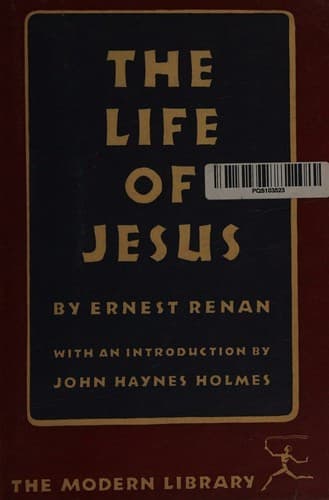
Christian biography -- Palestine; Jesus Christ -- Biography
The lapse of time has changed that which constituted the power of the
great founder of Christianity into something offensive to our ideas,
and if ever the worship of Jesus loses its hold upon mankind, it will
be precisely on account of those acts which originally inspired belief
in him. Criticism experiences no embarrassment in presence of this
kind of historical phenomenon. A thaumaturgus of our days, unless of
an extreme simplicity, like that manifested by certain stigmatists of
Germany, is odious; for he performs miracles without believing in
them; and is a mere charlatan. But, if we take a Francis d'Assisi, the
question becomes altogether different; the series of miracles
attending the origin of the order of St. Francis, far from offending
us, affords us real pleasure. The founder of Christianity lived in as
complete a state of poetic ignorance as did St. Clair and the _tres
socii_. The disciples deemed it quite natural that their master should
have interviews with Moses and Elias, that he should command the
elements, and that he should heal the sick. We must remember, besides,
that every idea loses something of its purity, as soon as it aspires
to realize itself. Success is never attained without some injury being
done to the sensibility of the soul. Such is the feebleness of the
human mind that the best causes are ofttimes gained only by bad
arguments. The demonstrations of the primitive apologists of
Christianity are supported by very poor reasonings. Moses, Christopher
Columbus, Mahomet, have only triumphed over obstacles by constantly
making allowance for the weakness of men, and by not always giving the
true reasons for the truth. It is probable that the hearers of Jesus
were more struck by his miracles than by his eminently divine
discourses. Let us add, that doubtless popular rumor, both before and
after the death of Jesus, exaggerated enormously the number of
occurrences of this kind. The types of the gospel miracles, in fact,
do not present much variety; they are repetitions of each other and
seem fashioned from a very small number of models, accommodated to the
taste of the country.
Public-domain text, read in full here on John Shaqi.
Reviews
Reviews
No reviews yet
Be the first to share your thoughts on this work.
Elsewhere in the archive
Join the Discussion
Join the discussion
Sign in to leave a comment or review.
Sign InorCreate an account