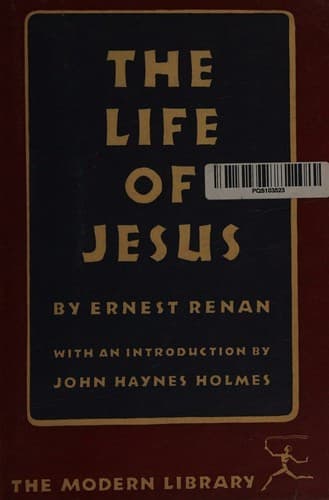
Christian biography -- Palestine; Jesus Christ -- Biography
It is impossible, amongst the miraculous narratives so tediously
enumerated in the Gospels, to distinguish the miracles attributed to
Jesus by public opinion from those in which he consented to play an
active part. It is especially impossible to ascertain whether the
offensive circumstances attending them, the groanings, the
strugglings, and other features savoring of jugglery,[1] are really
historical, or whether they are the fruit of the belief of the
compilers, strongly imbued with theurgy, and living, in this respect,
in a world analogous to that of the "spiritualists" of our times.[2]
Almost all the miracles which Jesus thought he performed, appear to
have been miracles of healing. Medicine was at this period in Judea,
what it still is in the East, that is to say, in no respect
scientific, but absolutely surrendered to individual inspiration.
Scientific medicine, founded by Greece five centuries before, was at
the time of Jesus unknown to the Jews of Palestine. In such a state of
knowledge, the presence of a superior man, treating the diseased with
gentleness, and giving him by some sensible signs the assurance of his
recovery, is often a decisive remedy. Who would dare to say that in
many cases, always excepting certain peculiar injuries, the touch of
a superior being is not equal to all the resources of pharmacy? The
mere pleasure of seeing him cures. He gives only a smile, or a hope,
but these are not in vain.
[Footnote 1: Luke viii. 45, 46; John xi. 33 and 38.]
[Footnote 2: _Acts_ ii. 2, and following, iv. 31, viii. 15, and
following, x. 44 and following. For nearly a century, the apostles and
their disciples dreamed only of miracles. See the _Acts_, the writings
of St. Paul, the extracts from Papias, in Eusebius, _Hist. Eccl._,
iii. 39, &c. Comp. Mark iii. 15, xvi. 17, 18, 20.]
Jesus had no more idea than his countrymen of a rational medical
science; he believed, like every one else, that healing was to be
effected by religious practices, and such a belief was perfectly
consistent. From the moment that disease was regarded as the
punishment of sin,[1] or as the act of a demon,[2] and by no means as
the result of physical causes, the best physician was the holy man who
had power in the supernatural world. Healing was considered a moral
act; Jesus, who felt his moral power, would believe himself specially
gifted to heal. Convinced that the touching of his robe,[3] the
imposition of his hands,[4] did good to the sick, he would have been
unfeeling, if he had refused to those who suffered, a solace which it
was in his power to bestow. The healing of the sick was considered as
one of the signs of the kingdom of God, and was always associated with
the emancipation of the poor.[5] Both were the signs of the great
revolution which was to end in the redress of all infirmities.
[Footnote 1: John v. 14, ix. 1, and following, 34.]
[Footnote 2: Matt. ix. 32, 33, xii. 22; Luke xiii. 11, 16.]
[Footnote 3: Luke viii. 45, 46.]
Public-domain text, read in full here on John Shaqi.
Reviews
Reviews
No reviews yet
Be the first to share your thoughts on this work.
Elsewhere in the archive
Join the Discussion
Join the discussion
Sign in to leave a comment or review.
Sign InorCreate an account