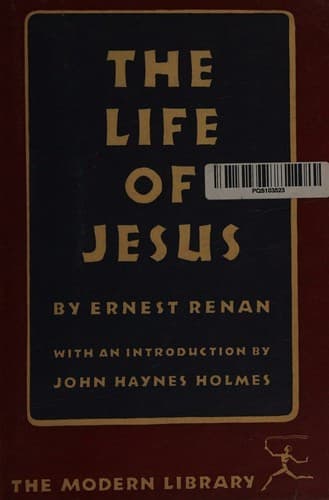
Christian biography -- Palestine; Jesus Christ -- Biography
This mysterious rite obtained great importance in the lifetime of
Jesus. It was probably established some time before the last journey
to Jerusalem, and it was the result of a general doctrine much more
than a determinate act. After the death of Jesus, it became the great
symbol of Christian communion,[1] and it is to the most solemn moment
of the life of the Saviour that its establishment is referred. It was
wished to see, in the consecration of bread and wine, a farewell
memorial which Jesus, at the moment of quitting life, had left to his
disciples.[2] They recognized Jesus himself in this sacrament. The
wholly spiritual idea of the presence of souls, which was one of the
most familiar to the Master, which made him say, for instance, that he
was personally with his disciples[3] when they were assembled in his
name, rendered this easily admissible. Jesus, we have already said,
never had a very defined notion of that which constitutes
individuality. In the degree of exaltation to which he had attained,
the ideal surpassed everything to such an extent that the body counted
for nothing. We are one when we love one another, when we live in
dependence on each other; it was thus that he and his disciples were
one.[4] His disciples adopted the same language. Those who for years
had lived with him, had seen him constantly take the bread and the cup
"between his holy and venerable hands,"[5] and thus offer himself to
them. It was he whom they ate and drank; he became the true passover,
the former one having been abrogated by his blood. It is impossible to
translate into our essentially determined idiom, in which a rigorous
distinction between the material and the metaphorical must always be
observed, habits of style the essential character of which is to
attribute to metaphor, or rather to the idea it represents, a complete
reality.
[Footnote 1: _Acts_ ii. 42, 46.]
[Footnote 2: 1 _Cor._ xi. 20, and following.]
[Footnote 3: Matt. xviii. 20.]
[Footnote 4: John xii. entirely.]
[Footnote 5: Canon of the Greek Masses and the Latin Mass (very
ancient).]
CHAPTER XIX.
INCREASING PROGRESSION OF ENTHUSIASM AND OF EXALTATION.
Public-domain text, read in full here on John Shaqi.
Reviews
Reviews
No reviews yet
Be the first to share your thoughts on this work.
Elsewhere in the archive
Join the Discussion
Join the discussion
Sign in to leave a comment or review.
Sign InorCreate an account