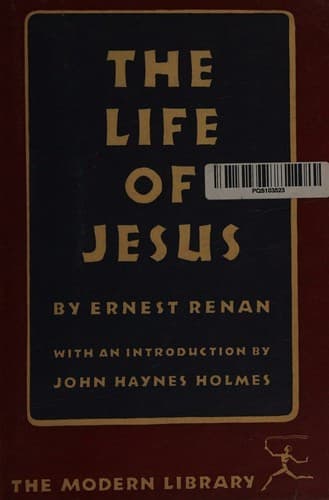
Christian biography -- Palestine; Jesus Christ -- Biography
Each moment of this eventful period is solemn, and counts more than
whole ages in the history of humanity. We have arrived at the
Thursday, 13th of Nisan (2d April). The evening of the next day
commenced the festival of the Passover, begun by the feast in which
the Paschal lamb was eaten. The festival continued for seven days,
during which unleavened bread was eaten. The first and the last of
these seven days were peculiarly solemn. The disciples were already
occupied with preparations for the feast.[1] As to Jesus, we are led
to believe that he knew of the treachery of Judas, and that he
suspected the fate that awaited him. In the evening he took his last
repast with his disciples. It was not the ritual feast of the
passover, as was afterward supposed, owing to an error of a day in
reckoning,[2] but for the primitive church this supper of the
Thursday was the true passover, the seal of the new covenant. Each
disciple connected with it his most cherished remembrances, and
numerous touching traits of the Master which each one preserved were
associated with this repast, which became the corner-stone of
Christian piety, and the starting-point of the most fruitful
institutions.
[Footnote 1: Matt. xxvi. 1, and following; Mark xiv. 12; Luke xxii. 7;
John xiii. 29.]
[Footnote 2: This is the system of the synoptics (Matt. xxvi. 17, and
following; Mark xiv. 12, and following; Luke xxii. 7, and following,
15.) But John, whose narrative of this portion has a greater
authority, expressly states that Jesus died the same day on which the
Paschal lamb was eaten (xiii. 1, 2, 29, xviii. 28, xix. 14, 31.) The
Talmud also makes Jesus to die "on the eve of the Passover" (Talm. of
Bab., _Sanhedrim_, 43 _a_, 67 _a_.)]
Doubtless the tender love which filled the heart of Jesus for the
little church which surrounded him overflowed at this moment,[1] and
his strong and serene soul became buoyant, even under the weight of
the gloomy preoccupations that beset him. He had a word for each of
his friends; two among them especially, John and Peter, were the
objects of tender marks of attachment. John (at least according to his
own account) was reclining on the divan, by the side of Jesus, his
head resting upon the breast of the Master. Toward the end of the
repast, the secret which weighed upon the heart of Jesus almost
escaped him: he said, "Verily I say unto you, that one of you shall
betray me."[2] To these simple men this was a moment of anguish; they
looked at each other, and each questioned himself. Judas was present;
perhaps Jesus, who had for some time had reasons to suspect him,
sought by this expression to draw from his looks or from his
embarrassed manner the confession of his fault. But the unfaithful
disciple did not lose countenance; he even dared, it is said, to ask
with the others: "Master, is it I?"
[Footnote 1: John xiii. 1, and following.]
Public-domain text, read in full here on John Shaqi.
Reviews
Reviews
No reviews yet
Be the first to share your thoughts on this work.
Elsewhere in the archive
Join the Discussion
Join the discussion
Sign in to leave a comment or review.
Sign InorCreate an account