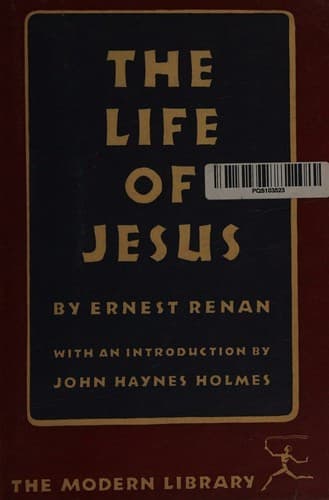
Christian biography -- Palestine; Jesus Christ -- Biography
[Footnote 2: Matt. xxvi. 21, and following; Mark xiv. 18, and
following; Luke xx. 21, and following; John xiii. 21, and following,
xxi. 20.]
Meanwhile, the good and upright soul of Peter was in torture. He made
a sign to John to endeavor to ascertain of whom the Master spoke.
John, who could converse with Jesus without being heard, asked him the
meaning of this enigma. Jesus having only suspicions, did not wish to
pronounce any name; he only told John to observe to whom he was going
to offer a sop. At the same time he soaked the bread and offered it to
Judas. John and Peter alone had cognizance of the fact. Jesus
addressed to Judas words which contained a bitter reproach, but which
were not understood by those present; and he left the company. They
thought that Jesus was simply giving him orders for the morrow's
feast.[1]
[Footnote 1: John xiii. 21, and following, which shows the
improbabilities of the narrative of the synoptics.]
At the time, this repast struck no one; and apart from the
apprehensions which the Master confided to his disciples, who only
half understood them, nothing extraordinary took place. But after the
death of Jesus, they attached to this evening a singularly solemn
meaning, and the imagination of believers spread a coloring of sweet
mysticism over it. The last hours of a cherished friend are those we
best remember. By an inevitable illusion, we attribute to the
conversations we have then had with him a meaning which death alone
gives to them; we concentrate into a few hours the memories of many
years. The greater part of the disciples saw their Master no more
after the supper of which we have just spoken. It was the farewell
banquet. In this repast, as in many others, Jesus practised his
mysterious rite of the breaking of bread. As it was early believed
that the repast in question took place on the day of the Passover, and
was the Paschal feast, the idea naturally arose that the Eucharistic
institution was established at this supreme moment. Starting from the
hypothesis that Jesus knew beforehand the precise moment of his death,
the disciples were led to suppose that he reserved a number of
important acts for his last hours. As, moreover, one of the
fundamental ideas of the first Christians was that the death of Jesus
had been a sacrifice, replacing all those of the ancient Law, the
"Last Supper," which was supposed to have taken place, once for all,
on the eve of the Passion, became the supreme sacrifice--the act which
constituted the new alliance--the sign of the blood shed for the
salvation of all.[1] The bread and wine, placed in connection with
death itself, were thus the image of the new testament that Jesus had
sealed with his sufferings--the commemoration of the sacrifice of
Christ until his advent.[2]
[Footnote 1: Luke xxii. 20.]
[Footnote 2: 1 _Cor._ xi. 26.]
Public-domain text, read in full here on John Shaqi.
Reviews
Reviews
No reviews yet
Be the first to share your thoughts on this work.
Elsewhere in the archive
Join the Discussion
Join the discussion
Sign in to leave a comment or review.
Sign InorCreate an account