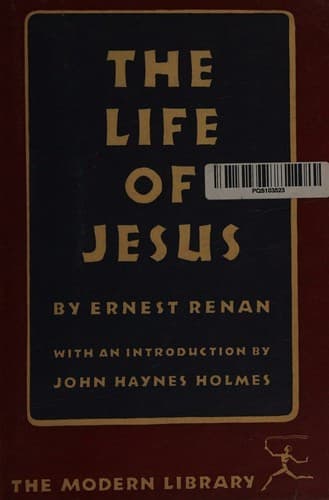
Christian biography -- Palestine; Jesus Christ -- Biography
It was, then, neither Tiberius nor Pilate who condemned Jesus. It was
the old Jewish party; it was the Mosaic Law. According to our modern
ideas, there is no transmission of moral demerit from father to son;
no one is accountable to human or divine justice except for that which
he himself has done. Consequently, every Jew who suffers to-day for
the murder of Jesus has a right to complain, for he might have acted
as did Simon the Cyrenean; at any rate, he might not have been with
those who cried "Crucify him!" But nations, like individuals, have
their responsibilities, and if ever crime was the crime of a nation,
it was the death of Jesus. This death was "legal" in the sense that it
was primarily caused by a law which was the very soul of the nation.
The Mosaic law, in its modern, but still in its accepted form,
pronounced the penalty of death against all attempts to change the
established worship. Now, there is no doubt that Jesus attacked this
worship, and aspired to destroy it. The Jews expressed this to Pilate
with a truthful simplicity: "We have a law, and by our law he ought to
die; because he has made himself the Son of God."[1] The law was
detestable, but it was the law of ancient ferocity; and the hero who
offered himself in order to abrogate it, had first of all to endure
its penalty.
[Footnote 1: John xix. 7.]
Alas! it has required more than eighteen hundred years for the blood
that he shed to bear its fruits. Tortures and death have been
inflicted for ages in the name of Jesus, on thinkers as noble as
himself. Even at the present time, in countries which call themselves
Christian, penalties are pronounced for religious offences. Jesus is
not responsible for these errors. He could not foresee that people,
with mistaken imaginations, would one day imagine him as a frightful
Moloch, greedy of burnt flesh. Christianity has been intolerant, but
intolerance is not essentially a Christian fact. It is a Jewish fact
in the sense that it was Judaism which first introduced the theory of
the absolute in religion, and laid down the principle that every
innovator, even if he brings miracles to support his doctrine, ought
to be stoned without trial.[1] The pagan world has also had its
religious violences. But if it had had this law, how would it have
become Christian? The Pentateuch has thus been in the world the first
code of religious terrorism. Judaism has given the example of an
immutable dogma armed with the sword. If, instead of pursuing the Jews
with a blind hatred, Christianity had abolished the regime which
killed its founder, how much more consistent would it have been!--how
much better would it have deserved of the human race!
[Footnote 1: _Deut._ xiii. 1, and following.]
CHAPTER XXV.
DEATH OF JESUS.
Public-domain text, read in full here on John Shaqi.
Reviews
Reviews
No reviews yet
Be the first to share your thoughts on this work.
Elsewhere in the archive
Join the Discussion
Join the discussion
Sign in to leave a comment or review.
Sign InorCreate an account