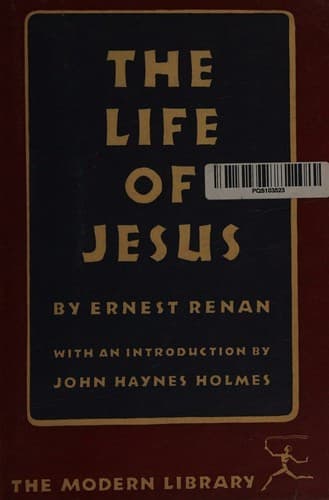
Christian biography -- Palestine; Jesus Christ -- Biography
Although the real motive for the death of Jesus was entirely
religious, his enemies had succeeded, in the judgment-hall, in
representing him as guilty of treason against the state; they could
not have obtained from the sceptical Pilate a condemnation simply on
the ground of heterodoxy. Consistently with this idea, the priests
demanded, through the people, the crucifixion of Jesus. This
punishment was not Jewish in its origin; if the condemnation of Jesus
had been purely Mosaic, he would have been stoned.[1] Crucifixion was
a Roman punishment, reserved for slaves, and for cases in which it was
wished to add to death the aggravation of ignominy. In applying it to
Jesus, they treated him as they treated highway robbers, brigands,
bandits, or those enemies of inferior rank to whom the Romans did not
grant the honor of death by the sword.[2] It was the chimerical "King
of the Jews," not the heterodox dogmatist, who was punished. Following
out the same idea, the execution was left to the Romans. We know that
amongst the Romans, the soldiers, their profession being to kill,
performed the office of executioners. Jesus was therefore delivered to
a cohort of auxiliary troops, and all the most hateful features of
executions introduced by the cruel habits of the new conquerors, were
exhibited toward him. It was about noon.[3] They re-clothed him with
the garments which they had removed for the farce enacted at the
tribunal, and as the cohort had already in reserve two thieves who
were to be executed, the three prisoners were taken together, and the
procession set out for the place of execution.
[Footnote 1: Jos., _Ant._, XX. ix. 1. The Talmud, which represents the
condemnation of Jesus as entirely religious, declares, in fact, that
he was stoned; or, at least, that after having been hanged, he was
stoned, as often happened (Mishnah, _Sanhedrim_, vi. 4.) Talmud of
Jerusalem, _Sanhedrim_, xiv. 16. Talm. of Bab., same treatise, 43 _a_,
67 _a_.]
[Footnote 2: Jos., _Ant._, XVII. x. 10, XX. vi. 2; _B.J._, V. xi. 1;
Apuleius, _Metam._, iii. 9; Suetonius, _Galba_, 9; Lampridius, _Alex.
Sev._, 23.]
[Footnote 3: John xix. 14. According to Mark xv. 25, it could scarcely
have been eight o'clock in the morning, since that evangelist relates
that Jesus was crucified at nine o'clock.]
Public-domain text, read in full here on John Shaqi.
Reviews
Reviews
No reviews yet
Be the first to share your thoughts on this work.
Elsewhere in the archive
Join the Discussion
Join the discussion
Sign in to leave a comment or review.
Sign InorCreate an account