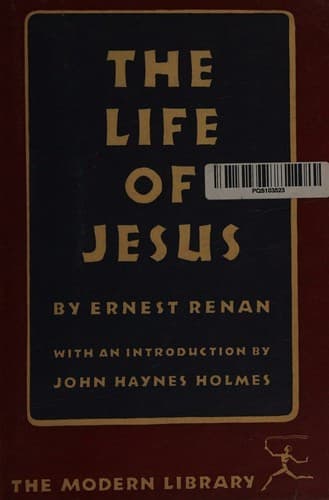
Christian biography -- Palestine; Jesus Christ -- Biography
According to the Roman custom, the corpse of Jesus ought to have
remained suspended in order to become the prey of birds.[1] According
to the Jewish law, it would have been removed in the evening, and
deposited in the place of infamy set apart for the burial of those who
were executed.[2] If Jesus had had for disciples only his poor
Galileans, timid and without influence, the latter course would have
been adopted. But we have seen that, in spite of his small success at
Jerusalem, Jesus had gained the sympathy of some important persons who
expected the kingdom of God, and who, without confessing themselves
his disciples, were strongly attached to him. One of these persons,
Joseph, of the small town of Arimathea (_Ha-ramathaim_[3]), went in
the evening to ask the body from the procurator.[4] Joseph was a rich
and honorable man, a member of the Sanhedrim. The Roman law, at this
period, commanded, moreover, that the body of the person executed
should be delivered to those who claimed it.[5] Pilate, who was
ignorant of the circumstance of the _crurifragium_, was astonished
that Jesus was so soon dead, and summoned the centurion who had
superintended the execution, in order to know how this was. Pilate,
after having received the assurances of the centurion, granted to
Joseph the object of his request. The body probably had already been
removed from the cross. They delivered it to Joseph, that he might do
with it as he pleased.
[Footnote 1: Horace, _Epistles_, I. xvi. 48; Juvenal, xiv. 77; Lucan.,
vii. 544; Plautus, _Miles glor._, II. iv. 19; Artemidorus, _Onir._,
ii. 53; Pliny, xxxvi. 24; Plutarch, _Life of Cleomenes_, 39;
Petronius, _Sat._, cxi.-cxii.]
[Footnote 2: Mishnah, _Sanhedrim_, vi. 5.]
[Footnote 3: Probably identical with the ancient Rama of Samuel, in
the tribe of Ephraim.]
[Footnote 4: Matt. xxvii. 57, and following; Mark xv. 42, and
following; Luke xxiii. 50, and following; John xix. 38, and
following.]
[Footnote 5: Dig. XLVIII. xxiv., _De cadaveribus puntorum_.]
Another secret friend, Nicodemus,[1] whom we have already seen
employing his influence more than once in favor of Jesus, came forward
at this moment. He arrived, bearing ample provision of the materials
necessary for embalming. Joseph and Nicodemus interred Jesus according
to the Jewish custom--that is to say, they wrapped him in a sheet with
myrrh and aloes. The Galilean women were present,[2] and no doubt
accompanied the scene with piercing cries and tears.
[Footnote 1: John xix. 39, and following.]
[Footnote 2: Matt. xxvii. 61; Mark xv. 47; Luke xxiii. 55.]
Public-domain text, read in full here on John Shaqi.
Reviews
Reviews
No reviews yet
Be the first to share your thoughts on this work.
Elsewhere in the archive
Join the Discussion
Join the discussion
Sign in to leave a comment or review.
Sign InorCreate an account