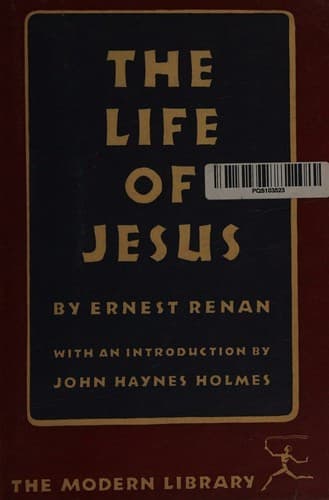
Christian biography -- Palestine; Jesus Christ -- Biography
It was late, and all this was done in great haste. The place had not
yet been chosen where the body would be finally deposited. The
carrying of the body, moreover, might have been delayed to a late
hour, and have involved a violation of the Sabbath--now the disciples
still conscientiously observed the prescriptions of the Jewish law. A
temporary interment was determined upon.[1] There was at hand, in the
garden, a tomb recently dug out in the rock, which had never been
used. It belonged, probably, to one of the believers.[2] The funeral
caves, when they were destined for a single body, were composed of a
small room, at the bottom of which the place for the body was marked
by a trough or couch let into the wall, and surmounted by an arch.[3]
As these caves were dug out of the sides of sloping rocks, they were
entered by the floor; the door was shut by a stone very difficult to
move. Jesus was deposited in the cave, and the stone was rolled to the
door, as it was intended to return in order to give him a more
complete burial. But the next day being a solemn Sabbath, the labor
was postponed till the day following.[4]
[Footnote 1: John xix. 41, 42.]
[Footnote 2: One tradition (Matt. xxvii. 60) designates Joseph of
Arimathea himself as owner of the cave.]
[Footnote 3: The cave which, at the period of Constantine, was
considered as the tomb of Christ, was of this shape, as may be
gathered from the description of Arculphus (in Mabillon, _Acta SS.
Ord. S. Bened._, sec. iii., pars ii., p. 504), and from the vague
traditions which still exist at Jerusalem among the Greek clergy on
the state of the rock now concealed by the little chapel of the Holy
Sepulchre. But the indications by which, under Constantine, it was
sought to identify this tomb with that of Christ, were feeble or
worthless (see especially Sozomen, _H.E._, ii. 1.) Even if we were to
admit the position of Golgotha as nearly exact, the Holy Sepulchre
would still have no very reliable character of authenticity. At all
events, the aspect of the places has been totally modified.]
[Footnote 4: Luke xxiii. 56.]
The women retired after having carefully noticed how the body was
laid. They employed the hours of the evening which remained to them in
making new preparations for the embalming. On the Saturday all
rested.[1]
[Footnote 1: Luke xxiii. 54-56.]
Public-domain text, read in full here on John Shaqi.
Reviews
Reviews
No reviews yet
Be the first to share your thoughts on this work.
Elsewhere in the archive
Join the Discussion
Join the discussion
Sign in to leave a comment or review.
Sign InorCreate an account