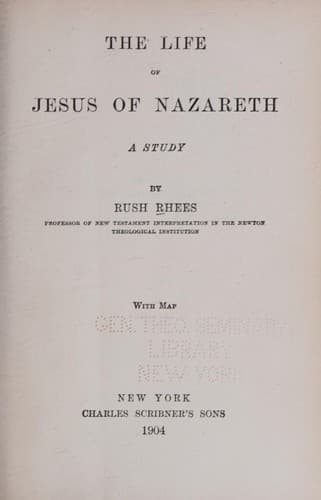
31. The fourth gospel gives us a picture of Jesus in striking contrast to
that of the other three. These present chiefly the works of the Master and
his teachings concerning the kingdom of God and human conduct, leaving the
truth concerning the teacher himself to be inferred. John opens the heart
of Jesus and makes him disclose his thought about himself in a remarkable
series of teachings of which he is the prime topic. This gospel is
avowedly an argument (xx. 30, 31); its selection of material is
confessedly partial; its aim is to confirm the faith of Christians in the
heavenly nature and saving power of their Lord; and its method is that of
appeal to testimony, to signs, and to his own self-disclosures. The
opening verses of the gospel have a somewhat abstract theological
character; the body of the book, however, consists of a succession of
incidents and teachings which follow each other in unstudied fashion like
a collection of annals. This impression is not compromised by the
recognition, at some points, of accidental displacements, like that which
has placed xiv. 30, 31 before xv. and xvi., or that which has left a long
gap between vii. 23 and the incident of v. 1-9, to which it refers. The
theme of the gospel is the self-disclosure of Jesus. This seems to have
determined the evangelist's choice of material, and, as the gospel is an
argument, he does not hesitate to mingle his own comments with his report
of Jesus' words, for example (iii. 16-21, 30-36; xii. 37-43). The book is
characterized by a vividness of detail which indicates a clear memory of
personal experience. While it is evident that the author has the most
exalted conception of the nature of his Lord, this seems to have been the
result of loving meditation on a friend who had early won the mastery over
his heart and life, and who through long years of contemplation had forced
upon his disciple's mind the conviction of his transcendent nature. The
book discloses a profoundly objective attitude; the Christ whom John
portrays is not the creature of his speculations, but the Master who has
entered into his experience as a living influence and has compelled
recognition of his significance. The Son of God is for John the human
Jesus who, though named at the outset the Word--the Logos,--is the Word
who was made flesh, that men through him might become the sons of God.
Public-domain text, read in full here on John Shaqi.
Reviews
Reviews
No reviews yet
Be the first to share your thoughts on this work.
Join the Discussion
Join the discussion
Sign in to leave a comment or review.
Sign InorCreate an account