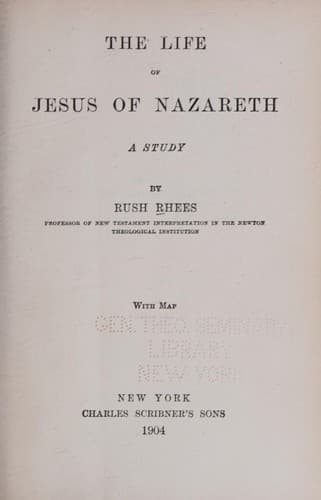
The Life of Jesus of Nazareth: A Study — John Shaqi
The Life of Jesus of Nazareth: A StudyRhees, Rush
Religion
The Life of Jesus of Nazareth: A Study
Rhees, Rush
Jesus Christ -- Biography
34. We have in our gospel records, therefore, two authorities for the
general course of the ministry of Jesus,--Mark and John. Even if the
fourth gospel should be proved not to be the work of John, its picture of
the ministry of Jesus must be recognized as coming from some apostolic
source. A forger would hardly have invited the rejection of his work by
inventing a narrative which seems to contradict at so many points the
tradition of the other gospels. The first and third gospels furnish us
from various sources rich additions to Mark's narrative, and it is to
these two with the fourth that we turn chiefly for the teachings of Jesus.
Each gospel should be read, therefore, remembering its incompleteness,
remembering also the particular purpose and individual enthusiasm for
Jesus which produced it.
35. A word may be due to two other claimants to recognition as original
records from the life of Jesus. One class is represented by that word of
the Lord which Paul quoted to the Ephesian elders at Miletus (Acts xx.
35). Scattered here and there in writings of the apostolic and succeeding
ages are other sayings attributed to Jesus which cannot be found in our
gospels. A few of these so-called Agrapha seem worthy of him, and are
recognized as probably genuine. The most important of them is the story of
the woman taken in adultery (John vii. 53 to viii. 11), which, though not
a part of the gospel of John, doubtless gives a true incident from Jesus'
life. They represent the "many other" things which John and the other
gospels have omitted, but their small number proves that our gospels have
preserved for us practically all that was known of Jesus after the first
witnesses fell asleep. It is certainly surprising that so little exists to
supplement the story of the gospels, for they are manifestly fragmentary,
and leave much of Jesus' public life without any record. The other class
of claimants is of a quite different character,--the so-called Apocryphal
Gospels. These consist chiefly of legends connected with the birth and
early years of Jesus, and with his death and resurrection. They are for
the most part crude tales that have entirely mistaken the real character
of him whom they seek to exalt, and need only to be read to be rejected.
III
The Harmony of the Gospels
36. The church early appreciated the value and the difficulty of having
four different pictures of the life and teachings of the Lord. Irenæus at
the close of the second century felt it to be as essential that there
should be four gospels as that there should be "four zones of the world,
four principal winds, and four faces of the cherubim" (Against Heresies
III. ii. 8).
Public-domain text, read in full here on John Shaqi.
Reviews
Reviews
No reviews yet
Be the first to share your thoughts on this work.
Join the Discussion
Join the discussion
Sign in to leave a comment or review.
Sign InorCreate an account