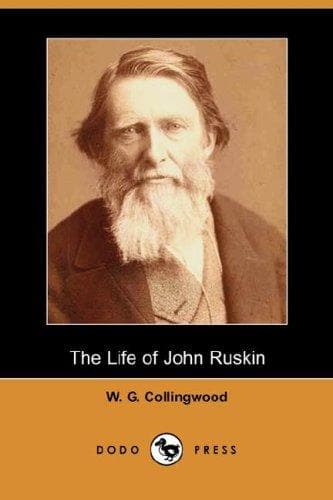
The Life of John RuskinCollingwood, W. G. (William Gershom)
Philosophy
The Life of John Ruskin
Collingwood, W. G. (William Gershom)
Authors, English -- 19th century -- Biography; Ruskin, John, 1819-1900
During the time when he was preaching his later doctrines, he wished to
suppress the interfering evidences of the earlier. He let his works on
art run out of print, not for the benefit of second-hand booksellers,
but in the hope that he could fix his audience upon the burden of his
prophecy for the time being. But the youthful works were still read;
high prices were paid for them, or they were smuggled in from America.
And when the epoch of "Fors" had passed, he agreed to the reprinting of
all that early material. He called it obsolete and trivial; others find
it interestingly biographical--perhaps even classical.
This year, then, 1860, the year of the Italian Kingdom, of Garibaldi,
and of the beginning of the American war, marks his turning point, from
the early work, summed up in the old "Selections," to the later work.
Until he was forty, Mr. Ruskin was a writer on art; after that his art
was secondary to ethics. Until he was forty he was a believer in English
Protestantism; afterwards he could not reconcile current beliefs with
the facts of life as he saw them, and had to reconstruct his creed from
the foundations. Until he was forty he was a philanthropist, working
heartily with others in a definite cause, and hoping for the amendment
of wrongs, without a social upheaval. Even in the beginning of 1860, in
his evidence before the House of Commons Select Committee on Public
Institutions, he was ready with plans for amusing and instructing the
labouring classes, and noting in them a "thirsty desire" for
improvement. But while his readiness to make any personal sacrifice, in
the way of social and philanthropic experiment, and his interest in the
question were increasing, he became less and less sanguine about the
value of such efforts as the Working Men's College, and less and less
ready to co-operate with others in their schemes. He began to see that
no tinkering at social breakages was really worth while; that far more
extensive repairs were needed to make the old ship seaworthy.
So he set himself, by himself, to sketch the plans for the repairs.
Naturally sociable, and accustomed to the friendly give-and-take of a
wide acquaintance, he withdrew from the busy world into a busier
solitude. During the next few years he lived much alone among the Alps,
or at home, thinking out the problem; sometimes feeling, far more
acutely than was good for clear thought, the burden of the mission that
was laid upon him. In March, 1863, he wrote from his retreat at Mornex
to Norton:
"The loneliness is very great, and the peace in which I am at
present is only as if I had buried myself in a tuft of grass on a
battlefield wet with blood--for the cry of the earth about me is in
my ears continually, if I do not lay my head to the very ground."
And a few months later:
Public-domain text, read in full here on John Shaqi.
Reviews
Reviews
No reviews yet
Be the first to share your thoughts on this work.
Elsewhere in the archive
Join the Discussion
Join the discussion
Sign in to leave a comment or review.
Sign InorCreate an account