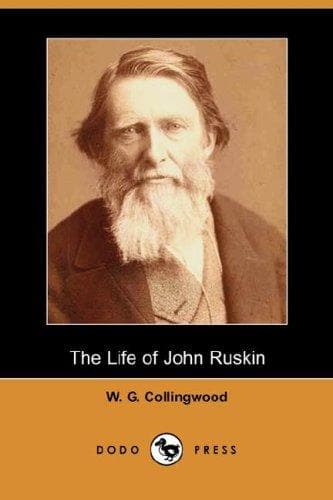
The Life of John RuskinCollingwood, W. G. (William Gershom)
Philosophy
The Life of John Ruskin
Collingwood, W. G. (William Gershom)
Authors, English -- 19th century -- Biography; Ruskin, John, 1819-1900
If one wanted more proof of that, there was his face, still
young-looking and beardless; made for expression, and sensitive to every
change of emotion. A long head, with enormous capacity of brain, veiled
by thick wavy hair, not affectedly lengthy but as abundant as ever, and
darkened into a deep brown, without a trace of grey; and short, light
whiskers growing high over his cheeks. A forehead not on the model of
the heroic type, but as if the sculptor had heaped his clay in handfuls
over the eyebrows, and then heaped more. A big nose, aquiline, and broad
at the base, with great thoroughbred nostrils and the "septum" between
them thin and deeply depressed; and there was a turn down at the corners
of the mouth, and a breadth of lower lip, that reminded one of his
Verona griffin, half eagle, half lion; Scotch in original type, and
suggesting a side to his character not all milk and roses. And under
shaggy eyebrows, ever so far behind, the fieriest blue eyes, that
changed with changing expression, from grave to gay, from lively to
severe; that riveted you, magnetised you, seemed to look through you and
read your soul; and indeed, when they lighted on you, you felt you had a
soul of a sort. What they really saw is a mystery. Some who had not
persuaded them to see as others see, maintained that they only saw what
they looked for; others, who had successfully deceived them, that they
saw nothing. No doubt they might be deceived; but I know now that they
often took far shrewder measurements of men--I do not say of women--than
anybody suspected.
For the Inaugural Course, he was, so to speak, on his best behaviour,
guarding against too hasty expression of individuality. He read careful
orations, stating his maturest views on the general theory of art, in
picked language, suited to the academic position. The little volume is
not discursive or entertaining, like "Modern Painters," and contains no
pictures either with pen or pencil; but it is crammed full of thought,
and of the results of thought.
Public-domain text, read in full here on John Shaqi.
Reviews
Reviews
No reviews yet
Be the first to share your thoughts on this work.
Elsewhere in the archive
Join the Discussion
Join the discussion
Sign in to leave a comment or review.
Sign InorCreate an account