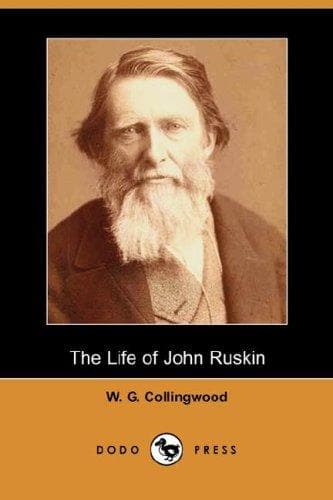
The Life of John RuskinCollingwood, W. G. (William Gershom)
Philosophy
The Life of John Ruskin
Collingwood, W. G. (William Gershom)
Authors, English -- 19th century -- Biography; Ruskin, John, 1819-1900
Meanwhile Ruskin practised what he preached. He did not preach
renunciation; he was not a Pessimist any more than an Optimist.
Sometimes he felt he was not doing enough; he knew very well that others
thought so. I remember his saying, in his rooms at Oxford in one of
those years: "Here I am, trying to reform the world, and I suppose I
ought to begin with myself, I am trying to do St. Benedict's work, and I
ought to be a saint. And yet I am living between a Turkey carpet and a
Titian, and drinking as much tea"--taking his second cup--"as I can
_swig_!"
That was the way he put it to an undergraduate; to a lady friend he
wrote later on, "I'm reading history of early saints, too, for my Amiens
book, and feel that I ought to be scratched, or starved, or boiled, or
something unpleasant; and I don't know if I'm a saint or a sinner in the
least, in mediæval language. How did the saints feel themselves, I
wonder, about their saintship!"
If he had forsaken all and followed the vocation of St. Francis,--he has
discussed the question candidly in "Fors" for May, 1874--would not his
work have been more effectual, his example more inspiring? Conceivably:
but that was not his mission. His gospel was not one of asceticism; it
called upon no one for any sort of suicide, or even martyrdom. He
required of his followers that they should live their lives to the full
in "Admiration, Hope and Love": and not that they should sacrifice
themselves in fasting and wearing of camels'-hair coats. He wished them
to work, to be honest, and just, in all things immediately attainable.
He asked the tenth of their living--not the widow's two mites; and it
was deeply painful to him to find, sometimes, that they had so
interpreted his teaching: as when he wrote, later, to Miss Beever:
"One of my poor 'Companions of St. George' who has sent me, not a
widow's but a parlour-maid's (an old schoolmistress) 'all her
living,' and whom I found last night, dying, slowly and quietly, in
a damp room, just the size of your study (which her landlord won't
mend the roof of), by the light of a single tallow candle,--dying,
I say, _slowly_ of consumption, not yet near the end, but
contemplating it with sorrow, mixed partly with fear lest she
should not have done all she could for her children! The sight of
this and my own shameful comforts, three wax candles and blazing
fire and dry roof, and Susie and Joanie for friends! Oh me, Susie,
what _is_ to become of me in the next world, who have in this life
all my good things!"
Public-domain text, read in full here on John Shaqi.
Reviews
Reviews
No reviews yet
Be the first to share your thoughts on this work.
Elsewhere in the archive
Join the Discussion
Join the discussion
Sign in to leave a comment or review.
Sign InorCreate an account