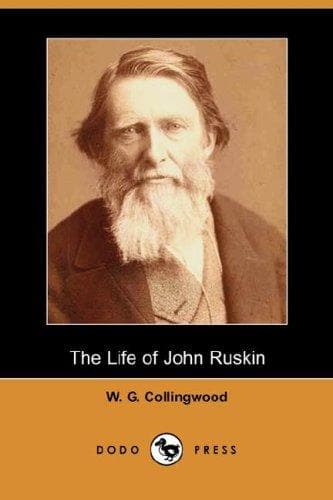
The Life of John RuskinCollingwood, W. G. (William Gershom)
Philosophy
The Life of John Ruskin
Collingwood, W. G. (William Gershom)
Authors, English -- 19th century -- Biography; Ruskin, John, 1819-1900
Ruskin did not wish to lead a colony or to head a revolution. He had
been pondering for fifteen years the cause of poverty and crime, and the
conviction had grown upon him that modern commercialism was at the root
of it all. But his attacks on commercialism--his analysis of its bad
influence on all sections of society--were too vigorous and
uncompromising for the newspaper editors who received "Fors," and even
for most of his private friends. There were, however, some who saw what
he was aiming at: and let it be remarked that his first encouragement
came from the highest quarters. Just as Sydney Smith, the chief critic
of earlier days, had been the first to praise "Modern Painters," in the
teeth of vulgar opinion, so now Carlyle spoke for "Fors."
"5, Cheyne Row, Chelsea, _April 30th_, 1871.
"Dear Ruskin,
"This 'Fors Clavigera,' Letter 5th, which I have just finished reading,
is incomparable; a quasi-sacred consolation to me, which almost brings
tears into my eyes! Every word of it is as if spoken, not out of my poor
heart only, but out of the eternal skies; words winged with Empyrean
wisdom, piercing as lightning,--and which I really do not remember to
have heard the like of. _Continue_, while you have such utterances in
you, to give them voice. They will find and force entrance into human
hearts, _whatever_ the 'angle of incidence' may be; that is to say,
whether, for the degraded and _in_ human Blockheadism we, so-called
'men,' have mostly now become, you come in upon them at the broadside,
at the top, or even at the bottom. Euge, Euge!--Yours ever,
"T. Carlyle."
Others, like Sir Arthur Helps, joined in this encouragement. But the old
struggle with the newspapers began over again.
They united in considering the whole business insane, though they did
not doubt his sincerity when Ruskin put down his own money, the tenth of
what he had, as he recommended his adherents to do. By the end of the
year he had set aside £7,000 toward establishing a company to be called
of "St. George," as representing at once England and agriculture. Sir
Thomas Dyke Acland and the Right Hon. W. Cowper-Temple (afterwards Lord
Mount Temple), though not pledging themselves to approval of the scheme,
undertook the trusteeship of the fund. A few friends subscribed; in
June, 1872, after a year and a half of "Fors," the first stranger sent
in his contribution, and at the end of three years £236 13s. were
collected, to add to his £7,000, and a few acres of land were given.
Public-domain text, read in full here on John Shaqi.
Reviews
Reviews
No reviews yet
Be the first to share your thoughts on this work.
Elsewhere in the archive
Join the Discussion
Join the discussion
Sign in to leave a comment or review.
Sign InorCreate an account