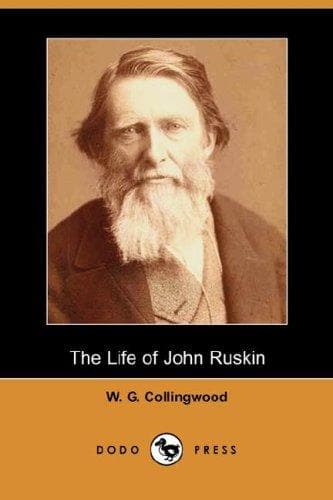
The Life of John RuskinCollingwood, W. G. (William Gershom)
Philosophy
The Life of John Ruskin
Collingwood, W. G. (William Gershom)
Authors, English -- 19th century -- Biography; Ruskin, John, 1819-1900
If you are a man, you are told not to dress; if you are a lady, you may
put on your prettiest gown. They dine in the new room, for the old
dining-room was so small that the waitress could not get round the
table. The new room is spacious and lofty compared with the rest of the
house; it has a long window with thick red sandstone mullions--there at
last is a touch of Gothicism--to look down the lake, and a bay window
open on the narrow lawn sloping steeply down to the road in front, and
the view of the Old Man. The walls, painted "duck egg," are hung with
old pictures; the Doge Gritti, a bit saved from the great Titian that
was burnt in the fire at the Ducal Palace in 1574; a couple of
Tintorets; Turner and Reynolds, each painted by himself in youth;
Raphael by a pupil, so it is said; portraits of old Mr. and Mrs. Ruskin,
and little John and his "boo hills." There he sits, no longer little,
opposite: and you can trace the same curve and droop of the eyebrows
prefigured in the young face and preserved in the old, and a certain
family likeness to his handsome young father.
Since Mr. Ruskin's illness his cousin, Mrs. Arthur Severn, has become
more and more indispensable to him: she sits at the head of the table
and calls him "the coz." An eminent visitor was once put greatly out of
countenance by this apparent irreverence. After obvious embarrassment,
light dawned upon him towards the close of the meal. "Oh!" said he,
"it's 'the coz' you call Mr. Ruskin. I thought you were saying' the
cuss!'"
There are generally two or three young people staying in the house,
salaried assistants[43] or amateur, occasional helpers; but though there
is a succession of visitors from a distance, there is not very frequent
entertainment of neighbours.
[Footnote 43: The face most familiar at Brantwood in those times was
"Laurie's." A strange, bright, gifted boy--admirable draughtsman,
ingenious mechanician, marvellous actor; the imaginer of the quaintest
and drollest humours that ever entered the head of man; devoted to boats
and boating, but unselfishly ready to share all labours and contribute
to all diversions; painstaking and perfect in his work, and brilliant in
his wit,--Laurence Hilliard was dearly loved by his friends, and is
still loved by them dearly. He was Ruskin's chief secretary at Brantwood
from Jan., 1876 to 1882, when the death of his father, and ill-health,
led him to resign the post, which was then filled by Miss Sara D.
Anderson. Hilliard continued to live at Coniston, and was just beginning
to succeed as a painter of still life and landscape when he died of
pleurisy on board a friend's yacht in the Aegean, April 11th, 1887, aged
thirty-two.]
Public-domain text, read in full here on John Shaqi.
Reviews
Reviews
No reviews yet
Be the first to share your thoughts on this work.
Elsewhere in the archive
Join the Discussion
Join the discussion
Sign in to leave a comment or review.
Sign InorCreate an account