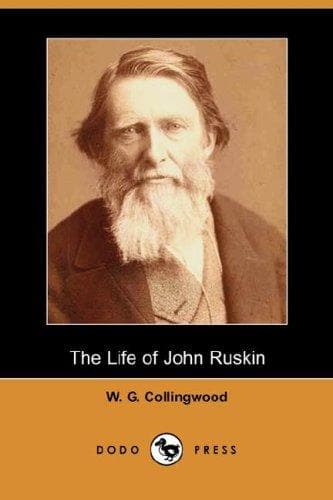
The Life of John RuskinCollingwood, W. G. (William Gershom)
Philosophy
The Life of John Ruskin
Collingwood, W. G. (William Gershom)
Authors, English -- 19th century -- Biography; Ruskin, John, 1819-1900
[Footnote 46: Since then become part of the Brantwood estate.]
Coming down from the moor after the round, when you reach the front door
you must see the performance of the waterfall: everybody must see that.
On the moor a reservoir has been dug and dammed, with ingenious
flood-gates--Ruskin's device, of course--and a channel led down through
the wood to a rustic bridge in the rock. Some one has stayed behind to
let out the water, and down it comes; first a black stream and then a
white one, as it gradually clears; and the rocky wall at the entrance
becomes for ten minutes a cascade. This too has it uses; not only is
there a supply of water in case of fire (the exact utilisation of which
is yet undecided), but it illustrates one of his doctrines about the
simplicity with which works of irrigation could be carried out among the
hills of Italy.
And so you go in to tea and chess, for he loves a good game of chess
with all his heart. He loves many things, you have found. He is
different from other men you know, by the breadth and vividness of his
sympathies, by power of living as few other men can live, in Admiration,
Hope and Love.
CHAPTER VII
"FORS" RESUMED (1880-1881)
Retirement at Brantwood was only partial. Ruskin's habits of life made
it impossible for him to be idle, much as he acknowledged the need of
thorough rest. He could not be wholly ignorant of the world outside
Coniston; though sometimes for weeks together he tried to ignore it, and
refused to read a newspaper. The time when General Gordon went out to
Khartoum was one of these periods of abstraction, devoted to mediæval
study. Somebody talked one morning at breakfast about the Soudan. "And
who _is_ the Soudan?" he earnestly inquired, connecting the name, as it
seemed, with the Soldan of Babylon, in crusading romance.
"Don't you know," he wrote to a friend (January 8th, 1880):
"That I am entirely with you in this Irish misery, and have been
these thirty years?--only one can't speak plain without distinctly
becoming a leader of Revolution? I know that Revolution _must come_
in all the world--but I can't act with Dan ton or Robespierre, nor
with the modern French Republican or Italian one. I _could_ with
you and your Irish, but you are only at the beginning of the end. I
have spoken,--and plainly too,--for all who have ears, and hear."
Public-domain text, read in full here on John Shaqi.
Reviews
Reviews
No reviews yet
Be the first to share your thoughts on this work.
Elsewhere in the archive
Join the Discussion
Join the discussion
Sign in to leave a comment or review.
Sign InorCreate an account