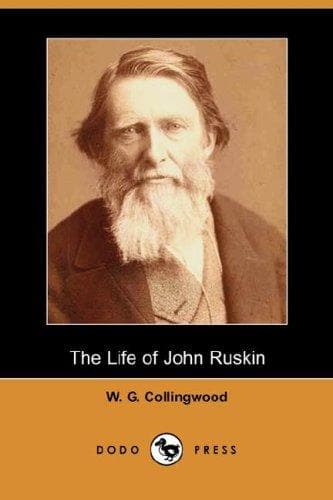
The Life of John RuskinCollingwood, W. G. (William Gershom)
Philosophy
The Life of John Ruskin
Collingwood, W. G. (William Gershom)
Authors, English -- 19th century -- Biography; Ruskin, John, 1819-1900
The author of "Fors" had tried to show that the nineteenth-century
commercialist spirit was not new; that the tyranny of capital was the
old sin of usury over again; and he asked why preachers of religion did
not denounce it--why, for example, the Bishop of Manchester did not, on
simply religious grounds, oppose the teaching of the "Manchester
School," who were the chief supporters of the commercialist economy. Not
until the end of 1879 had Dr. Fraser been aware of the challenge; but at
length he wrote, justifying his attitude. The popular and able bishop
had much to say on the expediency of the commercial system and the error
of taking the Bible literally; but he seemed unaware of the revolution
in economical thought which "Unto this Last" and "Fors" had been
pioneering.
"I'm not gone to Venice yet," wrote Ruskin to Miss Beever, "but thinking
of it hourly. I'm very nearly done with toasting my bishop; he just
wants another turn or two, and then a little butter." The toasting and
the buttering appeared in the _Contemporary Review_ for February 1880;
and this incident led him to feel that the mission of "Fors" was not
finished. If bishops were still unenlightened, there was yet work to do.
He gave up Venice, and resumed his crusade.
Brantwood life was occasionally interrupted by short excursions to
London or elsewhere. In the autumn he had heard Professor Huxley on the
evolution of reptiles; and this suggested another treatment of the
subject, from his own artistic and ethical point of view, in a lecture
oddly called "A Caution to Snakes," given at the London Institution,
March 17th, 1880 (repeated March 23rd, and printed in "Deucalion"). He
was not merely an amateur zoologist and F.Z.S., but a devoted lover and
keen observer of animals. It would take long to tell the story of all
his dogs, from the spaniel Dash, commemorated in his earliest poems, and
Wisie, whose sagacity is related in "Præterita," down through the long
line of bulldogs, St. Bernards, and collies, to Bramble, the reigning
favourite; and all the cats who made his study their home, or were
flirted with abroad. To Miss Beever, from Bolton Abbey (January 24th,
1875) he describes the Wharfe in flood, and then continues: "I came home
(to the hotel) to quiet tea, and a black kitten called Sweep, who lapped
half my cream-jugful (and yet I had plenty), sitting on my shoulder."
Grip, the pet rook at Denmark Hill, is mentioned in "My First Editor,"
as celebrated in verse by Mr. W.H. Harrison.
Public-domain text, read in full here on John Shaqi.
Reviews
Reviews
No reviews yet
Be the first to share your thoughts on this work.
Elsewhere in the archive
Join the Discussion
Join the discussion
Sign in to leave a comment or review.
Sign InorCreate an account