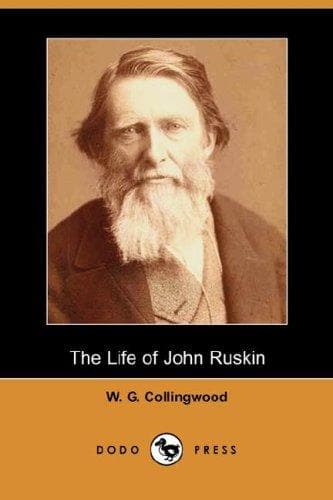
The Life of John RuskinCollingwood, W. G. (William Gershom)
Philosophy
The Life of John Ruskin
Collingwood, W. G. (William Gershom)
Authors, English -- 19th century -- Biography; Ruskin, John, 1819-1900
The recipient of the letter promptly sold it. Only three days later,
Ruskin was writing one of the most striking passages in "Præterita"
(vol. ii., chap. 5)--indeed, one of the daintiest landscape pieces in
all his works, describing the blue Rhone as it flows under the bridges
of Geneva.
This energetic letter-writing made people stare; but a more serious
result of these periods between strength and helplessness was the
tendency to misunderstanding with old friends. Ruskin had spoiled many
of them, if I may say so, by too uniform forbearance and unselfishness:
and now that he was not always strong enough to be patient, difficulties
ensued which they had not always the tact to avert. "The moment I have
to scold people they say I'm crazy," he said, piteously, one day. And
so, one hardly knows how, he found himself at strife on all sides.
Before he was fully recovered from the attack of 1886 there were
troubles about the Oxford drawing school; and he withdrew most of the
pictures he had there on loan. How little animosity he really felt
against Oxford is shown from the fact that early in the next year
(February, 1887) he was planning with his cousin, Wm. Richardson, to
give £5,000 to the drawing school, as a joint gift in memory of their
two mothers. Mr. Richardson's death, and Ruskin's want of means--for he
had already spent all his capital--put an end to the scheme. But the
remaining loans, including important and valuable drawings by himself,
he did not withdraw, and it is to be hoped they may stay there to show
not only the artist's hand but the friendly heart of the founder and
benefactor.
In April, 1887, came the news of Laurence Hilliard's death in the
Aegean, with a shock that intensified the tendency to another recurrence
of illness. For months the situation caused great anxiety. In August he
posted with Mrs. A. Severn towards the south, and took up his quarters
at Folkestone, moving soon after to Sandgate, where he remained, with
short visits to town, until the following summer--better, or worse, from
week to week--sometimes writing a little for "Præterita," or preparing
material for the continuation of unfinished books; but bringing on his
malady with each new effort. In June, 1888, he went with Mr. Arthur
Severn to Abbeville, and made his headquarters for nearly a month at the
Tête de Boeuf. Here he was arrested for sketching the fortifications and
examined at the police station, much to his amusement. At Abbeville,
too, he met Mr. Detmar Blow, a young architect, whom he asked to
accompany him to Italy. They stayed awhile at Paris,--drove, as in 1882,
over the Jura, and up to Chamouni, where Ruskin wrote the epilogue to
the reprint of "Modern Painters"; then, by Martigny and the Simplon,
they went to visit Mrs. and Miss Alexander at Bassano; and thence to
Venice. They returned by the St. Gothard, reaching Herne Hill early in
December.
Public-domain text, read in full here on John Shaqi.
Reviews
Reviews
No reviews yet
Be the first to share your thoughts on this work.
Elsewhere in the archive
Join the Discussion
Join the discussion
Sign in to leave a comment or review.
Sign InorCreate an account