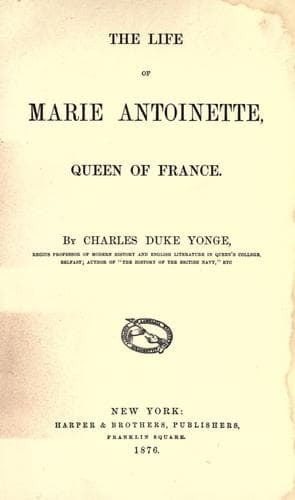
The Life of Marie Antoinette, Queen of FranceYonge, Charles Duke
History
The Life of Marie Antoinette, Queen of France
Yonge, Charles Duke
Marie Antoinette, Queen, consort of Louis XVI, King of France, 1755-1793
[Illustration: Marie Antoinette]
THE LIFE OF MARIE ANTOINETTE, QUEEN OF FRANCE.
BY CHARLES DUKE YONGE
1876
PREFACE.
The principal authorities for the following work are the four volumes of
Correspondence published by M. Arneth, and the six volumes published by M.
Feuillet de Conches. M. Arneth's two collections[1] contain not only a
number of letters which passed between the queen, her mother the Empress-
queen (Maria Teresa), and her brothers Joseph and Leopold, who
successively became emperors after the death of their father; but also a
regular series of letters from the imperial embassador at Paris, the Count
Mercy d'Argenteau, which may almost be said to form a complete history of
the court of France, especially in all the transactions in which Marie
Antoinette, whether as dauphiness or queen, was concerned, till the death
of Maria Teresa, at Christmas, 1780. The correspondence with her two
brothers, the emperors Joseph and Leopold, only ceases with the death of
the latter in March, 1792.
The collection published by M. Feuillet de Conches[2] has been vehemently
attacked, as containing a series of clever forgeries rather than of
genuine letters. And there does seem reason to believe that in a few
instances, chiefly in the earlier portion of the correspondence, the
critical acuteness of the editor was imposed upon, and that some of the
letters inserted were not written by the persons alleged to be the
authors. But of the majority of the letters there seems no solid ground
for questioning the authenticity. Indeed, in the later and more important
portion of the correspondence, that which belongs to the period after the
death of the Empress-queen, the genuineness of the Queen's letters is
continually supported by the collection of M. Arneth, who has himself
published many of them, having found them in the archives at Vienna, where
M.F. de Conches had previously copied them,[3] and who refers to others,
the publication of which did not come within his own plan. M. Feuillet de
Conches' work also contains narratives of some of the most important
transactions after the commencement of the Revolution, which are of great
value, as having been compiled from authentic sources.
Public-domain text, read in full here on John Shaqi.
Reviews
Reviews
No reviews yet
Be the first to share your thoughts on this work.
Join the Discussion
Join the discussion
Sign in to leave a comment or review.
Sign InorCreate an account