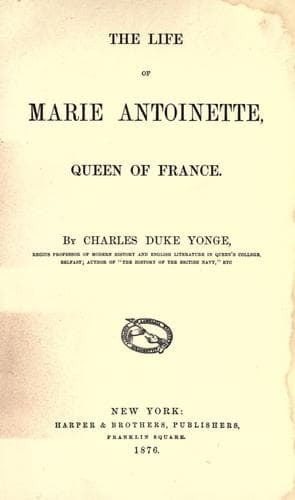
The Life of Marie Antoinette, Queen of FranceYonge, Charles Duke
History
The Life of Marie Antoinette, Queen of France
Yonge, Charles Duke
Marie Antoinette, Queen, consort of Louis XVI, King of France, 1755-1793
Such was a French court ball on days of most special ceremony, a somewhat
solemn affair, which required graciousness such as that of Marie
Antoinette to make admission to every one a very enviable privilege; even
though its stiffness had been in some degree relieved by a new regulation
of the queen, that the invitations, which had hitherto been confined to
matrons, should be extended to unmarried girls. Scarcely any change
produced greater consternation among the admirers of old customs. The
dowagers searched all the registers of those who had been admitted to the
court balls since the beginning of the century to fortify their
objections. But, to their dismay, some of the early festivities in the
time of Marie Leczinska proved to have been shared by one or two noble
maidens. The discovery was of little importance, since Marie Antoinette
had shown that she was not afraid of making precedents. But still it in
some degree silenced the grumblers, and for the rest of the reign no one
contested the queen's right to decide who should, and who should not, be
admitted to her society.
CHAPTER XI.
Tea is introduced.--Horse-racing of Count d'Artois.--Marie Antoinette goes
to see it--The Queen's Submissiveness to the Reproofs of the Empress.--
Birth of the Duc d'Angoulême.--She at times speaks lightly of the King.--
The Emperor remonstrates with her.--Character of some of the Queen's
Friends.--The Princess de Lamballe.--The Countess Jules de Polignac.--
They set the Queen against Turgot.--She procures his Dismissal.--She
gratifies Madame Polignac's Friends.--Her Regard for the French People.--
Water Parties on the Seine.--Her Health is Delicate.--Gambling at the
Palace.
Nor were these the only innovations which marked the age. A rage for
adopting English fashions--_Anglomanie_, as it was called--began to
prevail; and, among the different modes in which it exhibited itself, it
is especially noticed that tea[1] was now introduced, and began to share
with coffee the privileges of affording sober refreshment to those who
aspired in their different ways to give the tone to French society.
A less innocent novelty was a passion for horse-racing, in which the Comte
d'Artois and the Duc de Chartres set the example of indulging,
establishing a race-course in the Bois de Boulogne. The count had but
little difficulty in persuading the queen to attend it, and she soon
showed so decided a fancy for the sport, and became so regular a visitor
of it, that a small stand was built for her, which in subsequent years
provoked some unfavorable comments, when the princess obtained her leave
to give luncheon in it to some of their racing friends, who were not in
all instances of a character deserving to be brought into a royal
presence.
Public-domain text, read in full here on John Shaqi.
Reviews
Reviews
No reviews yet
Be the first to share your thoughts on this work.
Elsewhere in the archive
Join the Discussion
Join the discussion
Sign in to leave a comment or review.
Sign InorCreate an account