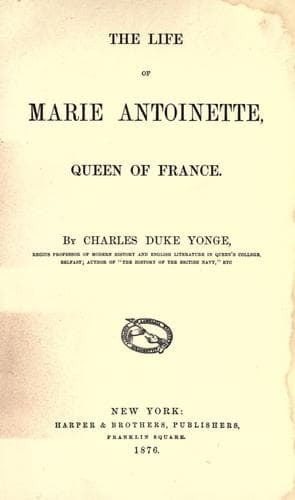
The Life of Marie Antoinette, Queen of FranceYonge, Charles Duke
History
The Life of Marie Antoinette, Queen of France
Yonge, Charles Duke
Marie Antoinette, Queen, consort of Louis XVI, King of France, 1755-1793
She pursued this, as she pursued every other amusement which she took up,
with great keenness for a while, so much so as to provoke earnest
remonstrances from her mother, whose letters were commonly dictated by
Mercy's reports and suggestions. Nor, if she felt uneasiness, did Maria
Teresa spare her daughter, or take any great care to moderate her language
of reproof. At times her tone is so severe as to excite a feeling of
wonder at the submissiveness with which her letters were received. No
express eulogy of her admirers could give so great an idea of Marie
Antoinette's amiability, good-nature, genuine modesty, and sincere
affection for her mother, as the ingenuousness with which she admits
errors, or the temper with which she urges excuses. To that venerated
parent she is just as patient of admonition, now that she is seated on a
throne, as she could have been in her schoolroom at Schönbrunn; and, in
reply to the scoldings (no milder word can do justice to the earnest
vehemence of the letters which at this time she received from Vienna), she
pleads not only that an appetite for amusement is natural to her age, but
that she enters into none of which the king does not fully approve, and
none which are ever allowed to interfere with her giving him full
enjoyment of her society whenever he has leisure or inclination for it.
But her replies to her mother hint also at the continuance of the old
causes for her restlessness, and for her eager pursuit of new diversions
to distract her thoughts. Her natural desire for children of her own was
greatly increased when, on the 12th of August, her sister-in-law, the
Countess d'Artois, presented her husband with a son.[2] She treated the
young mother with a sisterly kindness suited to the occasion, which
extorted the unqualified praise of Mercy himself; but she could not
restrain her feelings on the subject to her mother, and she expressed to
her frankly the extreme pain "which she suffered at thus seeing an heir to
the throne who was not her own child." Nor is it strange that at such
moments she should feel hurt at the coldness with which her husband
continued to behave toward her, or that she should ran eagerly after any
excitement which might aid in diverting her mind from a comparison of her
own position with that of her happier sister-in-law.[3]
Public-domain text, read in full here on John Shaqi.
Reviews
Reviews
No reviews yet
Be the first to share your thoughts on this work.
Elsewhere in the archive
Join the Discussion
Join the discussion
Sign in to leave a comment or review.
Sign InorCreate an account