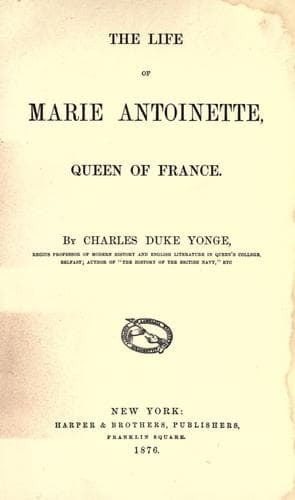
The Life of Marie Antoinette, Queen of FranceYonge, Charles Duke
History
The Life of Marie Antoinette, Queen of France
Yonge, Charles Duke
Marie Antoinette, Queen, consort of Louis XVI, King of France, 1755-1793
It would have been well if she had confined her expressions of
disappointment to her mother. But since we may not disguise her occasional
acts of imprudence, it must be confessed that at times her mortification
led her to speak of her husband to strangers in a tone of disparagement
which was highly unbecoming. Maximilian had been accompanied by the Count
de Rosenburg, who had in consequence been admitted to the intimate society
of the court during the archduke's visit, and who had inspired Marie
Antoinette with so favorable an opinion of his character and judgment that
after his return to Vienna she more than once sent him an account of the
proceedings at the palace since her brother's departure. She describes to
him a series of concerts, at which she had sung herself with some of her
ladies. She gives him a list of the guests, remarking, with a
particularity which seems to show that she expects her words to be
reported to the empress, that the gentlemen, though amiable and well bred,
were not young. But she also complains that the king's tastes do not
resemble hers, that he cares for nothing but hunting and mechanical
employments; and, indulging in an unwonted bit of sarcasm, she proceeds:
"You will allow that I should not look well beside a forge. I could never
become a Vulcan; and the part of Venus would displease him more than my
real tastes, which he does not disapprove." In another letter she mentions
him in a tone of contemptuous pity, almost equally unbecoming, speaking of
him as "the poor man" whom she had made a tool of to further some views of
her own, though Mercy assured the empress that her assertion of having so
treated him was a mere fiction of her imagination, to impart a sort of
lively tone to her letter; that, in spite of occasional outbursts of
levity, she had in reality the firmest affection and esteem for Louis; and
that nothing could be more irreproachable than her conduct toward him in
every respect. He added that the people in general did her full justice on
this head; that if her popularity with the Parisians had for a moment
suffered any diminution through the artifices of faction, the cloud had
been blown away; and that she had been recently received at the different
theatres with as fervent a loyalty as had greeted even her first
appearance.
Public-domain text, read in full here on John Shaqi.
Reviews
Reviews
No reviews yet
Be the first to share your thoughts on this work.
Elsewhere in the archive
Join the Discussion
Join the discussion
Sign in to leave a comment or review.
Sign InorCreate an account