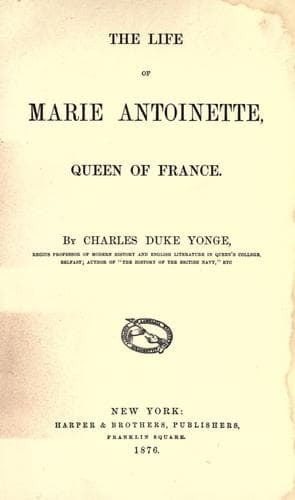
The Life of Marie Antoinette, Queen of FranceYonge, Charles Duke
History
The Life of Marie Antoinette, Queen of France
Yonge, Charles Duke
Marie Antoinette, Queen, consort of Louis XVI, King of France, 1755-1793
But the countess was a very different character. She had, indeed, a
well-bred air of good humor, but that, with her youth (she was but
twenty years of age), was her only qualification; for her capacity was
narrow, her disposition selfish and grasping, and she was so inveterate
a manoeuvrer, that, when she had no intrigues of her own on foot, she
was always ready to lend herself to the plots of others. What was worse,
she did not enjoy an untainted character. The name of the Comte de
Vaudreuil was often coupled with hers in the scandals of the court. And
the queen, since she could hardly be ignorant of the reports which were
circulated, incurred, by the marked favor which she showed to the
countess, the imputation of shutting her eyes to the frailties of her
friends, and thus showing that dissoluteness was not an insuperable
barrier to her partiality. It was only the earnest remonstrance of Mercy
which prevented her from conferring the place of lady of honor on the
countess; but she allowed her to exert a pernicious influence over her
in many ways, for the countess was unwearied in soliciting appointments
and pensions for her relatives; at times making demands in such numbers,
and of so exorbitant a character, that the queen herself was forced to
admit the impossibility of granting them all, though she still sought to
gratify her to far too great an extent, and would not allow the proved
insatiability of her and her family to open her eyes to her real
character.
It was, however, a far more mischievous submission to the influence of the
countess and her coterie, when she permitted them to prejudice her against
Turgot, whom she had more than once described to her mother as an upright
statesman, and who had constantly shown, so far as he could make
compliance consistent with his duty to the State, a sincere desire to
consult her wishes. But as the Polignac party saw in his prudence,
integrity, and firmness the most formidable obstacle to their project of
using the queen's favor to enrich themselves, she now yielded up her
judgment to their calumnies. Forgetting her former praises of the
minister's integrity, she began to disparage him as one whose measures
caused general dissatisfaction, and at last she pushed her hostility to
him so far that she actually tried to induce Louis not to be content with
dismissing him from office, but to send him as a prisoner to the
Bastille.[4] That she could not avoid feeling some shame at the part which
she had acted may be inferred from the pains which she took to conceal it
from her mother, whom she assured that, though she was not sorry for his
dismissal, she had in no degree interfered in the matter; but "her conduct
and even her intentions were well known, and known to be far removed from
all manoeuvres and intrigues.[5]"
Public-domain text, read in full here on John Shaqi.
Reviews
Reviews
No reviews yet
Be the first to share your thoughts on this work.
Elsewhere in the archive
Join the Discussion
Join the discussion
Sign in to leave a comment or review.
Sign InorCreate an account