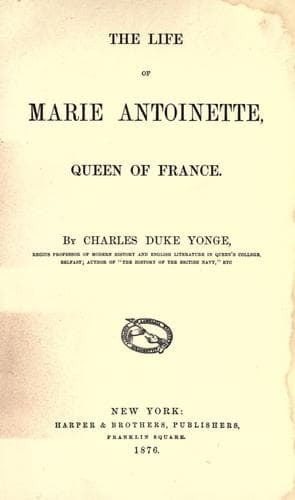
The Life of Marie Antoinette, Queen of FranceYonge, Charles Duke
History
The Life of Marie Antoinette, Queen of France
Yonge, Charles Duke
Marie Antoinette, Queen, consort of Louis XVI, King of France, 1755-1793
Unfortunately the ambassador's letters tell a different story. As a
sincere friend as well as a loyal servant of Marie Antoinette, he
expresses to the empress his deep feeling that, "as the comptroller-
general enjoyed a great reputation for integrity, and was beloved by the
people, it was a melancholy thing that his dismissal should be in part the
queen's work,[6]" and his fear that her conduct in the affair may
"hereafter bring upon her the reproaches of the king her husband, and even
of the entire nation." The foreboding thus uttered was but too sadly
realized. She had driven from her husband's councils the only man who
combined with the penetration to perceive the absolute necessity of a
large reform and the character of the changes required, the genius to
devise them and the firmness to carry them out.
Thirteen years later, a variety of causes, some of which will be unfolded
in the course of this narrative, had contributed to irritate the
impatience of the nation, while the unskillfulness of the existing
minister had disarmed the royal authority. And the very same reforms which
would now have been accepted with general thankfulness were then only used
by demagogues as a pretext for further inflaming the minds of the
multitude against every thing which bore the slightest appearance of
authority, even against the very sovereign who had granted them. France
and all Europe to this day feel the sad effects of Marie Antoinette's
interference.
She had given fatal proof of the truth of the words wrung from her by
nervous excitement at the moment of the late king's death, when she
declared that Louis and she were too young to reign; and the best excuse
that can be found for her is that she was not yet one-and-twenty. It was
not, however, wholly from submission to the interested malevolence of
others that she had shown herself the enemy of the great financier and
statesman. She had a spontaneous dislike to the retrenchments which
necessarily formed a great portion of his economical measures; not as
interfering with the indulgence of any extravagant tastes of her own, but
as restraining her power of gratifying her friends. For she was entirely
impressed with the idea that no person or body could have any right to
call in question the king's disposal of the national revenue; and that
there was no prerogative of the crown of which the exercise was more
becoming to the royal dignity than that of granting pensions or creating
sinecures with no limitations but such as might be imposed by his own will
or discretion. And on this point her husband fully shared her feelings.
"What," said he, on one occasion to Turgot, who was urging him to refuse
an utterly unwarrantable application for a pension. "What are a thousand
crowns a year?" "Sire," replied the minister, "they are the taxation of a
village." The king acquiesced for the moment, but probably not without
some secret wincing at the control to which he seemed to be subjected; and
Public-domain text, read in full here on John Shaqi.
Reviews
Reviews
No reviews yet
Be the first to share your thoughts on this work.
Elsewhere in the archive
Join the Discussion
Join the discussion
Sign in to leave a comment or review.
Sign InorCreate an account