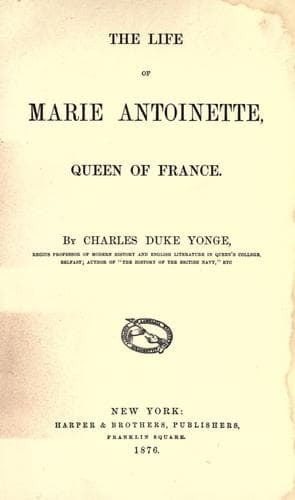
The Life of Marie Antoinette, Queen of FranceYonge, Charles Duke
History
The Life of Marie Antoinette, Queen of France
Yonge, Charles Duke
Marie Antoinette, Queen, consort of Louis XVI, King of France, 1755-1793
As the new year opened, affairs of a very different kind began to occupy
the queen's attention. On political questions, the advice which the
empress gave her differed in some degree from that of her embassador.
Maria Teresa was an earnest politician, but she was also a mother; and, as
being eager above all things for her daughter's happiness, while she
entreated Marie Antoinette to study politics, history, and such other
subjects as might qualify her to be an intelligent companion of the king,
and so far as or whenever he might require it, his chief confidante, she
warned her also against ever wishing to rule him. But Mercy was a
statesman above every thing, and, feeling secure of being able to guide
the queen, he desired to instill into her mind an ambition to govern the
king. On one most important question she proved wholly unable to do so,
since the decision taken was not even in accordance with the judgment or
inclination of Louis himself; but he allowed himself to be persuaded by
two of his ministers to adopt a course against which Joseph had earnestly
warned him in the preceding year, and which, as he had been then
convinced, was inconsistent alike with his position as a king and with his
interests as King of France.
England had been for some years engaged in a civil war with her colonies
in North America, and from the commencement of the contest a strong
sympathy for the colonists had been evinced by a considerable party in
France. Louis, who, for several reasons disliked England and English
ideas, was at first inclined to coincide in this feeling as a development
of anti-English principles: he was far from suspecting that its source was
rather a revolutionary and republican sentiment. But he had conversed with
his brother-in-law on the possibility of advantages which might accrue to
France from the weakening of her old foe, if French aid should enable the
Americans to establish their independence. Joseph's opinion was clear and
unhesitating: "I am a king; it is my business to be royalist." And he
easily convinced Louis that for one sovereign to assist the subjects of
another monarch who were in open revolt, was to set a mischievous example
which might in time be turned against himself. But since his return to
Vienna, unprecedented disasters had befallen England; a whole army had
laid down its arms; the ultimate success of the Americans seemed to every
statesman in Europe to be assured, and the prospect gave such
encouragement to the war party in the French cabinet that Louis could
resist it no longer. In February, 1778, a treaty was concluded with the
United States, as the insurgents called themselves; and France plunged
into a war from which she had nothing to gain, which involved her in
enormous expenses, which brought on her overwhelming defeats, and which,
from its effects upon the troops sent to serve with the American army, who
thus became infected with republican principles, had no slight influence
Public-domain text, read in full here on John Shaqi.
Reviews
Reviews
No reviews yet
Be the first to share your thoughts on this work.
Elsewhere in the archive
Join the Discussion
Join the discussion
Sign in to leave a comment or review.
Sign InorCreate an account