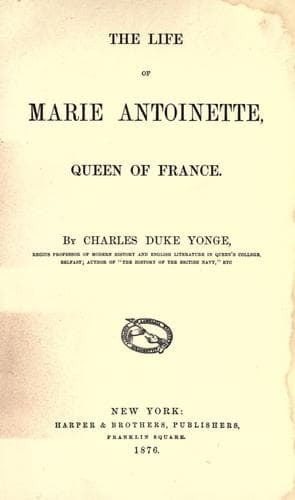
The Life of Marie Antoinette, Queen of FranceYonge, Charles Duke
History
The Life of Marie Antoinette, Queen of France
Yonge, Charles Duke
Marie Antoinette, Queen, consort of Louis XVI, King of France, 1755-1793
in bringing about the calamities which, a few years later, overwhelmed
both king and people.
All Marie Antoinette's language on the subject shows that she viewed the
quarrel with England with even greater repugnance than her husband; but it
is curious to see that her chief fear was lest the war should be waged by
land, and that she felt much greater confidence in the French navy than in
the army;[3] though it was just at this time that Voltaire was pointing
out to his countrymen that England had always enjoyed and always would
possess a maritime superiority which different inquirers might attribute
to various causes, but which none could deny.[4]
Even before the conclusion of this treaty, however, the Americans had
found sympathizers in France, to one of whom some of the circumstances of
the war which they were now waging gave a subsequent importance to which
no talents or virtues of his own entitled him. The Marquis de La Fayette
was a young man of ancient family, and of fair but not excessive fortune.
He was awkward in appearance and manner, gawky, red-haired, and singularly
deficient in the accomplishments which were cultivated by other youths of
his age and rank.[5] But he was deeply imbued with the doctrines of the
new philosophy which saw virtue in the mere fact of resistance to
authority; and when the colonists took up arms, he became eager to afford
them such aid as he could give. He made the acquaintance of Silas Deane,
one of the most unscrupulous of the American agents, who promised him,
though he was only twenty years of age, the rank of major-general. As he
was at all times the slave of a most overweening conceit, he was tempted
by that bait; and, though he could not leave France without incurring the
forfeiture of his military rank in the army of his own country, in April,
1777, he crossed over to America to serve as a volunteer under Washington,
who naturally received with special distinction a recruit of such
political importance. He was present at more than one battle, and was
wounded at Brandywine; but the exploit which made him most conspicuous was
a ridiculous act of bravado in sending a challenge to Lord Carlisle, the
chief of the English Commissioners who in 1778 were dispatched to America
to endeavor to re-establish peace. However, the close of the war, which
ended, as is well known, in the humiliation of Great Britain and the
establishment of the independence of the colonies, made him seem a hero to
his countrymen on his return. The queen, always eager to encourage and
reward feats of warlike enterprise, treated him with marked distinction,
and procured him from her husband not only the restoration of his
commission, but promotion to the command of a regiment;[6] kindness which,
as will be seen, he afterward requited with the foulest ingratitude.
Public-domain text, read in full here on John Shaqi.
Reviews
Reviews
No reviews yet
Be the first to share your thoughts on this work.
Elsewhere in the archive
Join the Discussion
Join the discussion
Sign in to leave a comment or review.
Sign InorCreate an account