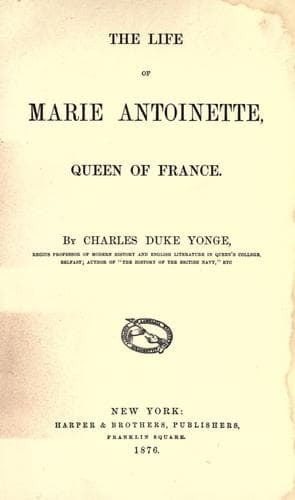
The Life of Marie Antoinette, Queen of FranceYonge, Charles Duke
History
The Life of Marie Antoinette, Queen of France
Yonge, Charles Duke
Marie Antoinette, Queen, consort of Louis XVI, King of France, 1755-1793
And in the last terrible hours, when the
monsters who had already murdered her husband were preparing the same fate
for herself, she met their hatred and ferocity with a loftiness of spirit
which even hopelessness could not subdue. Long before, she had declared
that she had learned, from the example of her mother, not to fear death;
and she showed that this was no empty boast when she rose in the last
scenes of her life as much even above her earlier displays of courage and
magnanimity as she also rose above the utmost malice of her vile enemies.
* * * * *
Marie Antoinette Josèphe Jeanne was the youngest daughter of Francis,
originally Duke of Lorraine, afterward Grand Duke of Tuscany, and
eventually Emperor of Germany, and of Maria Teresa, Archduchess of
Austria, Queen of Hungary and Bohemia, more generally known, after the
attainment of the imperial dignity by her husband in 1745, as the Empress-
queen. Of her brothers, two, Joseph and Leopold, succeeded in turn to the
imperial dignity; and one of her sisters, Caroline, became the wife of the
King of Naples. She was born on the 2d of November, 1755, a day which,
when her later years were darkened by misfortune, was often referred to as
having foreshadowed it by its evil omens, since it was that on which the
terrible earthquake which laid Lisbon in ruins reached its height. But, at
the time, the Viennese rejoiced too sincerely at every event which could
contribute to their sovereign's happiness to pay any regard to the
calamities of another capital, and the courtly poet was but giving
utterance to the unanimous feeling of her subjects when he spoke of the
princess's birth as calculated to diffuse universal joy. Daughters had
been by far the larger part of Maria Teresa's family, so that she was,
consequently, anxious for another son; and, knowing her wishes, the Duke
of Tarouka, one of the nobles whom she admitted to her intimacy, laid her
a small wager that they would be realized by the sex of the expected
infant. He lost his bet, but felt some embarrassment, in devising a
graceful mode of paying it. In his perplexity, he sought the advice of the
celebrated Metastasio, who had been for some time established at Vienna as
the favorite poet of the court, and the Italian, with the ready wit of his
country, at once supplied him with a quatrain, which, in her
disappointment itself, could mid ground for compliment:
"Io perdei; l' augusta figlia
A pagar m' ha condannato;
Ma s'è ver che a voi somiglia,
Tutto il mondo ha guadagnato."
Public-domain text, read in full here on John Shaqi.
Reviews
Reviews
No reviews yet
Be the first to share your thoughts on this work.
Join the Discussion
Join the discussion
Sign in to leave a comment or review.
Sign InorCreate an account