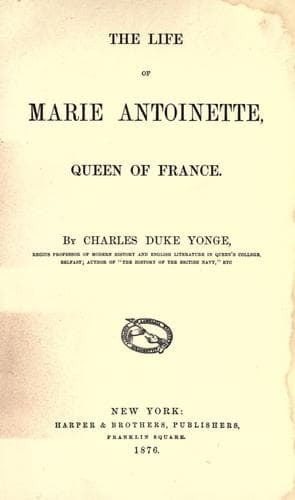
The Life of Marie Antoinette, Queen of FranceYonge, Charles Duke
History
The Life of Marie Antoinette, Queen of France
Yonge, Charles Duke
Marie Antoinette, Queen, consort of Louis XVI, King of France, 1755-1793
progress of the queen toward recovery; and then, giving his hand to the
queen of the fish-wives, the august pair, followed by their respective
suites, executed a dance expressive of their delight at the good news, and
then resumed their seats, and listened to Voltaire's "Zaire" with the most
edifying gravity.[6] It was evident that in some things there was already
enough, and rather more than enough, of that equality the unreasonable and
unpractical passion for which proved, a few years later, the most pregnant
cause of immeasurable misery to the whole nation.
But the demonstration most in accordance with the queen's own taste was
that which took place a few weeks later, when she went in a state
procession to the great national cathedral of Notre Dame to return thanks;
one most interesting part of the ceremony being the weddings of the
hundred young couples to whom she had given dowries, who also received a
silver medal to commemorate the day. The gayety of the spectacle, since
they, with the formal witnesses of their marriage, filled a great part of
the antechapel; and the blessings invoked on the queen's head as she left
the cathedral by the prisoners whom she had released, and by the poor
whose destitution she had relieved, made so great an impression on the
spectators, that even the highest dignitaries of the court added their
cheers and applause to those of the populace who escorted her coach to the
gates on its return to Versailles.
She was now, for the first time since her arrival in France, really and
entirely happy, without one vexation or one foreboding of evil. The king's
attachment to her was rendered, if not deeper than before, at least far
more lively and demonstrative by the birth of his daughter; his delight
carrying him at times to most unaccustomed ebullitions of gayety. On the
last Sunday of the carnival, he even went alone with the queen to the
masked opera ball, and was highly amused at finding that not one of the
company recognized either him or her. He even proposed to repeat his visit
on Shrove-Tuesday; but when the evening came he changed his mind, and
insisted on the queen's going by herself with one of her ladies, and the
change of plan led to an incident which at the time afforded great
amusement to Marie Antoinette, though it afterward proved a great
annoyance, as furnishing a pretext for malicious stories and scandal. To
preserve her _incognito_, a private carriage was hired for her, which
broke down in the street close by a silk-mercer's shop. As the queen was
already masked, the shop-men did not know her, and, at the request of the
lady who attended her, stopped for her the first hackney-coach which
passed, and in that unroyal vehicle, such as certainly no sovereign of
France had ever set foot in before, she at last reached the theatre. As
before, no one recognized her, and she might have enjoyed the scene and
returned to Versailles in the most absolute secrecy, had not her sense of
Public-domain text, read in full here on John Shaqi.
Reviews
Reviews
No reviews yet
Be the first to share your thoughts on this work.
Elsewhere in the archive
Join the Discussion
Join the discussion
Sign in to leave a comment or review.
Sign InorCreate an account