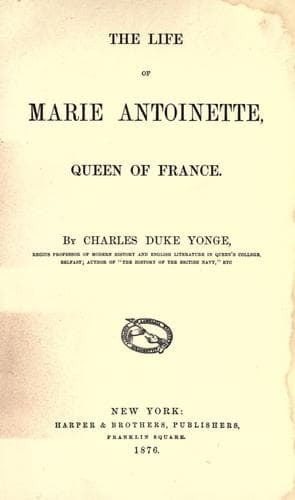
The Life of Marie Antoinette, Queen of FranceYonge, Charles Duke
History
The Life of Marie Antoinette, Queen of France
Yonge, Charles Duke
Marie Antoinette, Queen, consort of Louis XVI, King of France, 1755-1793
Marie Antoinette herself was scarcely disappointed at all. When the
attendants brought her her babe, she pressed it to her bosom. "Poor little
thing," said she, "you are not what was desired, but you shall not be the
less dear to me. A son would have belonged to the State; you will be my
own: you shall have all my care, you shall share my happiness and sweeten
my vexations.[4]"
The Count de Provence made no secret of his joy. He was still heir
presumptive to the throne. And, though no one shared his feelings on the
subject, for the next few weeks the whole kingdom, and especially the
capital, was absorbed in public rejoicings. Her own thankfullness was
displayed by Marie Antoinette in her usual way, by acts of benevolence.
She sent large sums of money to the prisons to release poor debtors; she
gave dowries to a hundred poor maidens; she applied to the chief officers
of both army and navy to recommend her veterans worthy of especial reward;
and to the curates of the metropolitan parishes to point out to her any
deserving objects of charity; and she also settled pensions on a number of
poor children who were born on the same day as the princess; one of whom,
who owed her education to this grateful and royal liberality, became
afterward known to every visitor of Paris as Madame Mars, the most
accomplished of comic actresses.[5]
One portion of the rejoicings was marked by a curious incident, in which
the same body whose right to a special place of honor at ceremonies
connected with the personal happiness of the royal family we have already
seen admitted--the ladies of the fish-market--again asserted their
pretensions with triumphant success. On Christmas-eve the theatres were
opened gratuitously, but these ladies, who, with their friends, the
coal-heavers, selected the most aristocratic theatre, La Comédie
Française, for the honor of their visit, arrived with aristocratic
unpunctuality, so late that the guards stopped them at the doors,
declaring that the house was full, and that there was not a seat vacant.
They declared that in any event room must be made for them. "Who were in
the boxes of the king and queen? for on such occasions those places were
theirs of right." Even they, however, were full, and the guards demurred
to the ladies' claim to be considered, though for this night only, as the
representatives of royalty, and to have the existing occupants of the
seats demanded turned out to make room for them. The box-keeper and the
manager were sent for. The registers of the house confirmed the validity
of the claim by former precedents, and a compromise was at last effected.
Rows of benches were placed on each side of the stage itself. Those on the
right were allotted to the coal-heavers as representatives of Louis; the
ladies of the fish-market sat on the left as the deputies of Marie
Antoinette. Before the play was allowed to begin, his majesty the king of
the coal-heavers read the bulletin of the day announcing the rapid
Public-domain text, read in full here on John Shaqi.
Reviews
Reviews
No reviews yet
Be the first to share your thoughts on this work.
Elsewhere in the archive
Join the Discussion
Join the discussion
Sign in to leave a comment or review.
Sign InorCreate an account