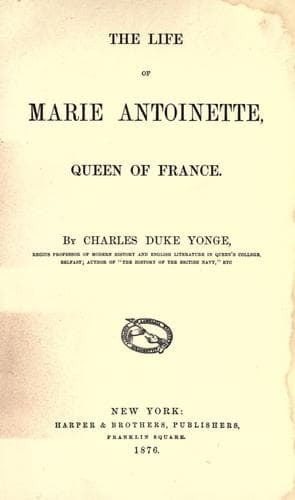
The Life of Marie Antoinette, Queen of FranceYonge, Charles Duke
History
The Life of Marie Antoinette, Queen of France
Yonge, Charles Duke
Marie Antoinette, Queen, consort of Louis XVI, King of France, 1755-1793
permanence which distinguishes no devotion but that which is pure and
noble, as he showed ten years later by the well-planned and courageous,
though unsuccessful, efforts which he made for the deliverance of the
queen and all her family.
That Marie Antoinette, who from early youth had shown an intuitive
accuracy of judgment in her estimate of character, should, from the very
first, honorably distinguish a man capable of such devotion to her service
was not unnatural; but there was another circumstance in his favor, which
he shared with the other foreign nobles, English and German, who in these
years were well received by the queen. Their disinterestedness presented a
striking contrast to the rapacity of the French. Every French noble valued
the court only for what he could obtain from it. Even Madame de Polignac,
whom the queen specially honored with the title of her friend, exhibited
an all-grasping covetousness, of which, with all her efforts to shut her
eyes to it, Marie Antoinette could not be unconscious; and her perception
of the difference between her French and her foreign courtiers was marked
by herself in a few words, when the Comte de la Marck, who was himself of
foreign extraction, ventured once to recommend to her greater caution in
her display of liking for the foreign nobles, as what might excite the
jealousy of the French;[8] and she replied that "he might be right, but
the foreigners were the only people who asked her for nothing."
Meanwhile, the war went on in America; the colonists themselves were
making but little, if any, progress, and the French contingent were
certainly reaping no honor, M. de La Fayette, the only officer who came in
contact with a British force, showing no military skill or capacity, and
not even much courage. But in the course of the spring France sustained a
far heavier loss than even the defeat of an army could have inflicted on
her, in the retirement of Necker from the ministry. As a statesman, he was
certainly not entitled to any very high rank. He had neither extensive
knowledge, nor large views, nor firmness; the only project of
constitutional reform which he had brought forward had been but a
mutilated and imperfect copy of the system devised by the original and
statesman-like daring of Turgot. At a subsequent period he proved himself
incapable of discerning the true character of the circumstances which
surrounded him, and wholly ignorant of the feelings of the nation, and of
the principles and objects of those who aspired to take a lead in its
councils. But as yet his financial policy had undoubtedly been successful.
He had greatly relieved the general distress, he had maintained the public
credit, and he had inspired the nation with confidence in itself, and
other countries also with confidence in its resources; but he had made
many and powerful enemies by the retrenchments which had been a necessary
part of his system. As early as the spring of 1780, Mercy had reported to
Public-domain text, read in full here on John Shaqi.
Reviews
Reviews
No reviews yet
Be the first to share your thoughts on this work.
Elsewhere in the archive
Join the Discussion
Join the discussion
Sign in to leave a comment or review.
Sign InorCreate an account