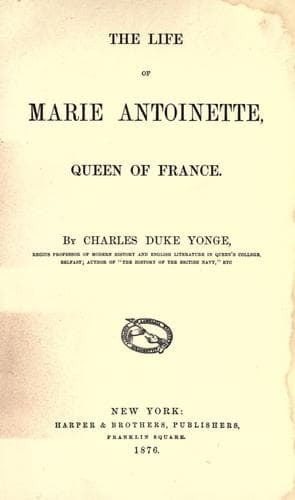
The Life of Marie Antoinette, Queen of FranceYonge, Charles Duke
History
The Life of Marie Antoinette, Queen of France
Yonge, Charles Duke
Marie Antoinette, Queen, consort of Louis XVI, King of France, 1755-1793
the empress that both the king's brothers and the Duc d'Orléans complained
that some of his measures infringed upon their established rights; that
the Count d'Artois had had a very stormy discussion with Necker himself,
and, when he could neither convince nor overbear him, had tried, though
unsuccessfully, to enlist the queen against him. The count had since
employed the controller of his own household, M. Boutourlin, to write
pamphlets against him, and, in point of fact, many of the most elaborate
details of a financial statement which Necker had recently published were
very ill-calculated to endure a strict scrutiny; but M. Boutourlin did his
work so badly that Necker had no difficulty in repelling him, and for a
moment seemed the stronger for the attack that had been made upon him.
He had been so far right in his estimate of his position that he could
rely on the support of the queen, who was aware that both her mother and
her brother had a high opinion of his integrity; but though the king also
had from time to time given his cordial sanction to his different
measures, it was not in the nature of Louis to withstand repeated pressure
and solicitation. Necker, too, himself unintentionally played into the
hands of his enemies. He had nominally only a subordinate position in the
ministry. As he was a Protestant, Louis had feared to offend the clergy by
giving him a seat in the council, or the title of comptroller-general; but
had conferred that post on M. Taboureau des Reaux, making Necker director
of the treasury under him. The real management of the exchequer was,
however, placed wholly in his hands; and, as he was one of the vainest of
men, he had gradually assumed a tone of importance as if his were the
paramount influence in the Government; going so far as even to open
negotiations with foreign statesmen to which none of his colleagues were
privy.[9] It was not strange that he was not very well satisfied with a
position which seemed as if it had been contrived in order to keep him out
of sight, and to deprive him of the credit belonging to his financial
successes; but hitherto he had been satisfied to bide his time. Now,
however, his triumph over M. Boutourlin seemed to him so to have
established his supremacy as to entitle him to insist on a promotion which
should be a public recognition of his position as the real minister of
finance, and as entitled to a preponderating voice in all matters of
general policy. He accordingly demanded admission to the council, and, on
its being refused, at once resigned his office.
Public-domain text, read in full here on John Shaqi.
Reviews
Reviews
No reviews yet
Be the first to share your thoughts on this work.
Elsewhere in the archive
Join the Discussion
Join the discussion
Sign in to leave a comment or review.
Sign InorCreate an account