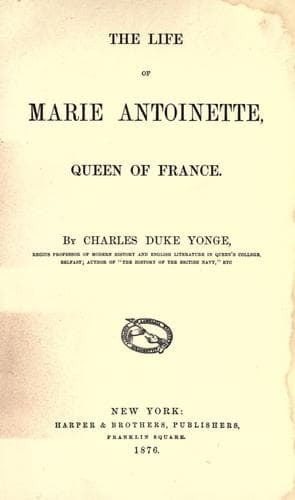
The Life of Marie Antoinette, Queen of FranceYonge, Charles Duke
History
The Life of Marie Antoinette, Queen of France
Yonge, Charles Duke
Marie Antoinette, Queen, consort of Louis XVI, King of France, 1755-1793
The king was assured that the passages which he had regarded as
mischievous were suppressed or divested of their sting. Marie Antoinette
apparently had her suspicions; but Louis could never long withstand
repeated solicitations, and, as he had not, when Madame de Campan read it,
formed any very high opinion of its literary merits, he thought that, now
that it was deprived of its venom, it would be looked upon as heavy, and
would fail accordingly. Some good judges, such as the Marquis de
Montesquieu, were of the same opinion. The actors thought differently. "It
is my belief," said a man of fashion to the witty Mademoiselle Arnould,
using the technical language of the theatre, "that your play will be
'damned.'" "Yes," she replied, "it will, fifty nights running." But, even
if Louis had heard of her prophecy, he would have disregarded it. He gave
his permission for the performance to take place, and on the 27th April,
1784, "The Marriage of Figaro" was accordingly acted to an audience which
filled the house to the very ceiling; and which the long uncertainty as to
whether it would ever be seen or not had disposed to applaud every scene
and every repartee, and even to see wit where none existed. To an
impartial critic, removed both by time and country from the agitation
which had taken place, it will probably seem that the play thus obtained a
reception far beyond its merits. It was undoubtedly what managers would
call a good acting play. Its plot was complicated without being confused.
It contained many striking situations; the dialogue was lively, but there
was more humor in the surprises and discoveries than verbal wit in the
repartees. Some strokes of satire were leveled at the grasping disposition
of the existing race of courtiers, whose whole trade was represented as
consisting of getting all they could, and asking for more; and others at
the tricks of modern politicians, feigning to be ignorant of what they
knew; to know what they were ignorant of; to keep secrets which had no
existence; to lock the door to mend a pen; to appear deep when they were
shallow; to set spies in motion, and to intercept letters; to try to
ennoble the poverty of their means by the grandeur of their objects. The
censorship, of course, did not escape. The scene being laid in Spain,
Figaro affirmed that at Madrid the liberty of the press meant that, so
long as an author spoke neither of authority, nor of public worship, nor
of politics, nor of morality, nor of men in power, nor of the opera, nor
of any other exhibition, nor of any one who was concerned in any thing, he
might print what be pleased. The lawyers were reproached with a scrupulous
adherence to forms, and a connivance at needless delays, which put money
into their pockets; and the nobles, with thinking that, as long as they
gave themselves the trouble to be born, society had no right to expect
from them any further useful action. But such satire was too general, it
Public-domain text, read in full here on John Shaqi.
Reviews
Reviews
No reviews yet
Be the first to share your thoughts on this work.
Elsewhere in the archive
Join the Discussion
Join the discussion
Sign in to leave a comment or review.
Sign InorCreate an account