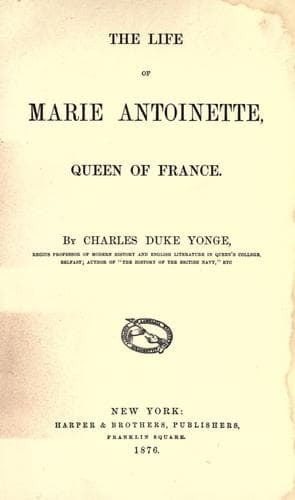
The Life of Marie Antoinette, Queen of FranceYonge, Charles Duke
History
The Life of Marie Antoinette, Queen of France
Yonge, Charles Duke
Marie Antoinette, Queen, consort of Louis XVI, King of France, 1755-1793
might have been thought, to cause uneasiness, much more to do specific
injury to any particular individual, or to any company or profession.
Figaro himself is represented as saying that none but little men feared
little writings.[3] And one of the advisers whom King Louis consulted as
to the possibility of any mischief arising from the performance of the
play, is said to have expressed his opinion in the form of an apothegm,
that "none but dead men were killed by jests." The author might even have
argued that his keenest satire had been poured upon those national
enemies, the English, when he declared what has been sometimes regarded as
the national oath to be the pith and marrow of the English language, the
open sesame to English society, the key to unlock the English heart, and
to obtain the judicious swearer all that he could desire.[4]
And an English writer, with English notions of the liberty of the press,
would hardly have thought it worth while to notice such an affair at all,
did he not feel bound to submit his judgment to that of the French
themselves. And if their view be correct, almost every institution in
France must have been a dead man past all hopes of recovery, since the
French historical writers, to whatever party they belong, are unanimous in
declaring that it was from this play that many of the oldest institutions
in the country received their death-blow, and that Beaumarchais was at
once the herald and the pioneer of the approaching Revolution.
Paris had scarcely cooled down after this excitement, when its attention
was more agreeably attracted by the arrival of a king, Gustavus III. of
Sweden. He had paid a visit to France in 1771, which had been cut short by
the sudden death of his father, necessitating his immediate return to his
own country to take possession of his throne; but the brief acquaintance
which Marie Antoinette had then made with him had inspired her with a
great admiration of his chivalrous character; and in the preceding year,
hearing that he was contemplating a tour in Southern Europe, she had
written to him to express a hope that he would repeat his visit to
Versailles, promising him "such a reception as was due to an ancient ally
of France;[5]" and adding that "she should personally have great pleasure
in testifying to him how greatly she valued his friendship."
Public-domain text, read in full here on John Shaqi.
Reviews
Reviews
No reviews yet
Be the first to share your thoughts on this work.
Elsewhere in the archive
Join the Discussion
Join the discussion
Sign in to leave a comment or review.
Sign InorCreate an account