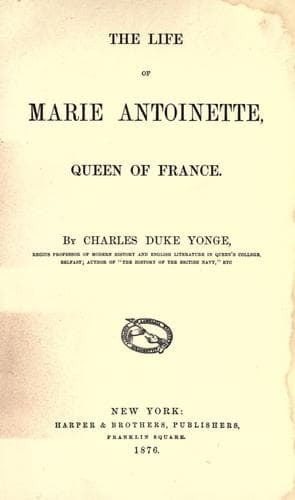
The Life of Marie Antoinette, Queen of FranceYonge, Charles Duke
History
The Life of Marie Antoinette, Queen of France
Yonge, Charles Duke
Marie Antoinette, Queen, consort of Louis XVI, King of France, 1755-1793
Her mention of the ancient alliance between the two countries, which,
indeed, had subsisted ever since the days of Francis I., was very welcome
to Gustavus, since the object of his journey was purely political, and he
desired to negotiate a fresh treaty. But those matters he, of course,
arranged with the ministers. The queen was only concerned in the
entertainments due from royal hosts to so distinguished a guest. Most of
them were of the ordinary character, there being a sort of established
routine of festivity for such occasions. And it may be taken as a proof
that the court had abated somewhat of its alarm at Beaumarchais's play
that "The Marriage of Figaro" was allowed to be acted on one of the king's
visits to the theatre. She also gave him an entertainment of more than
usual splendor at the Trianon, at which all the ladies present, and the
invitations were very numerous, were required to be dressed in white,
while all the walks and shrubberies of the garden were illuminated, so
that the whole scene presented a spectacle which he described in one of
his letters as "a complete fairy-land; a sight worthy of the Elysian
Fields themselves.[6]" But, as usual, the queen herself was the chief
ornament of the whole, as she moved graciously among her guests, laying
aside the character of queen to assume that of the cordial hostess; and
not even taking her place at the banquet, but devoting herself wholly to
the pleasurable duty of doing honor to her guests.
One of the displays was of a novel character, from which its inventors and
patrons expected scientific results of importance, which, though nearly a
century has since elapsed, have not yet been realized. In the preceding
year, Montgolfier had for the first time sent up a balloon, and the new
invention was now exhibited in the Court of Versailles: the queen allowed
the balloon to be called by her name; and, to the great admiration of
Gustavus, who had a decided taste for matters which were in any way
connected with practical science, the "Marie Antoinette" made a successful
voyage to Chantilly. The date of another invention, if, indeed, it
deserves so respectable a title, is also fixed by this royal visit. Mesmer
had recently begun to astonish or bewilder the Parisians with his theory
of animal magnetism; and Gustavus spent some time in discussing the
question with him, and seems for a moment to have flattered himself that
he comprehended his principles. But the only durable result which arose
from his stay in France was the sincere regard and esteem which he and the
queen mutually conceived for each other. They established a
correspondence, in which Marie Antoinette repeatedly showed her eagerness
to gratify his wishes and to attend to his recommendations; and when, at a
later period, unexpected troubles fell on her and her husband, there was
no one whom their troubles inspired with greater eagerness to serve them
than Gustavus, whose last projects, before he fell by the hand of an
Public-domain text, read in full here on John Shaqi.
Reviews
Reviews
No reviews yet
Be the first to share your thoughts on this work.
Elsewhere in the archive
Join the Discussion
Join the discussion
Sign in to leave a comment or review.
Sign InorCreate an account