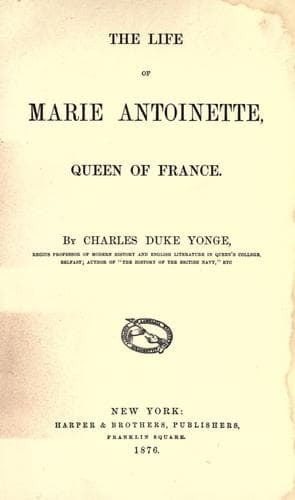
The Life of Marie Antoinette, Queen of FranceYonge, Charles Duke
History
The Life of Marie Antoinette, Queen of France
Yonge, Charles Duke
Marie Antoinette, Queen, consort of Louis XVI, King of France, 1755-1793
Meanwhile, she was again led to interest herself greatly in foreign
politics, though in truth she hardly regarded any thing in which her
brother's empire was interested as foreign, so deep was her conviction
that the interests of France and Austria were identical and inseparable,
and so unwearied were her endeavors to make her husband's ministers see
all questions that concerned her brother's dominions with her eyes.
Throughout the latter part of 1784, and the earlier months of 1785,
Joseph, who was always restless in his ambition, was full of schemes of
aggrandizement which he desired to carry out through the favor and
co-operation of France. At one moment he projected obtaining Bavaria in
exchange for the Netherlands, at another he aimed at procuring the opening
of the Scheldt by threatening the Dutch with instant war if they resisted.
But, as all these schemes were eventually abandoned, they would hardly
require to be mentioned here, were it not for the proofs which his
correspondence with his sister affords of his increasing esteem for her
capacity, and his evident conviction of her growing influence in the
French Government, and for the light which some of her answers to his
letters throw on her relations with the ministers, which had perhaps some
share in increasing the annoyance that the affair of "the necklace," as
will be presently mentioned, caused her before the end of the year. Her
difficulties with Louis himself were the same as she had already described
to her brother on former occasions. "It was impossible to induce him to
take a strong line, so as to speak resolutely to M. de Vergennes in her
presence, and equally so to prevent his changing his mind afterward;[5]"
while she distrusted the good faith of the minister so much that, though
she resolved to speak to him strongly on the subject, she would not do so
till she could discuss the question with him "in the presence of the king,
that he might not be able to disfigure or to exaggerate what she said."
Yet she did not always find her precautions effectual. Louis's judgment
was always at the mercy of the last speaker. She assured her brother that
"he had abundant reason to be contented with the king's personal feelings
on the subject. When he received the emperor's letter, he spoke to her
about it in a way that delighted her. He regarded Joseph's demands as
just, and his motives as most reasonable. Yet--she blushed to own it even
to her brother--after he had seen his minister, his tone was no longer the
same; he was embarrassed; he shunned the subject with her, and often found
some new objection to weaken the effect of his previous admissions."
Public-domain text, read in full here on John Shaqi.
Reviews
Reviews
No reviews yet
Be the first to share your thoughts on this work.
Elsewhere in the archive
Join the Discussion
Join the discussion
Sign in to leave a comment or review.
Sign InorCreate an account