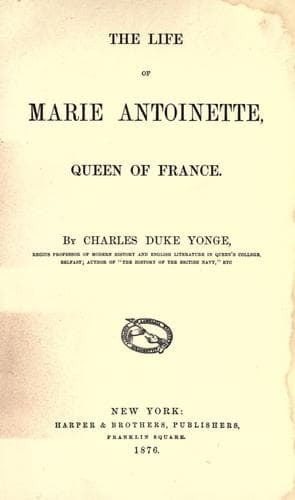
The Life of Marie Antoinette, Queen of FranceYonge, Charles Duke
History
The Life of Marie Antoinette, Queen of France
Yonge, Charles Duke
Marie Antoinette, Queen, consort of Louis XVI, King of France, 1755-1793
At one time she even feared a rupture between the two countries. Vergennes
was urging the king to send an army of observation to the frontier; and,
if it were sent, the proximity of such a force to the Austrian troops in
the Netherlands would, to her apprehension, be full of danger. There was
sound political acuteness in her remark that the dispatch of an army of
observation was not "in itself a declaration of war, but that when two
armies are so near to one another an order to advance is very soon
executed;" and, with a shrewd perception of the argument which was most
likely to influence the humane disposition of her husband, she pressed
upon him that "the delays and shuffling of his ministers might very
probably involve him in war, in spite of his own intentions." However,
eventually the clouds which had caused her anxiety were dissipated; the
mediation of France had even some share in leading to a conclusion of
these disputes in a manner in which Joseph himself acquiesced; and the
good understanding between the two crowns, on which, as Marie Antoinette
often declared, her happiness greatly depended, was preserved, or, as she
hoped, even strengthened, by the result of these negotiations.
But on one occasion of real moment to the personal comfort and credit of
the queen, Louis behaved with a clear good sense, and, what was equally
important, with a firmness which she gratefully acknowledged,[6] and
contrasted remarkably with the pusillanimous advice that had been given by
more than one of the ministers. That the affair in which he exhibited
these qualities should for a moment have been regarded as one of political
importance, is another testimony to the diseased state of the public mind
at the time; and that it should have been possible so to use it as to
attach the slightest degree of discredit to the queen, is a proof as
strange as melancholy how greatly the secret intrigues of the basest cabal
that ever disgraced a court had succeeded in undermining her reputation,
and poisoning the very hearts of the people against her.[7]
Public-domain text, read in full here on John Shaqi.
Reviews
Reviews
No reviews yet
Be the first to share your thoughts on this work.
Elsewhere in the archive
Join the Discussion
Join the discussion
Sign in to leave a comment or review.
Sign InorCreate an account