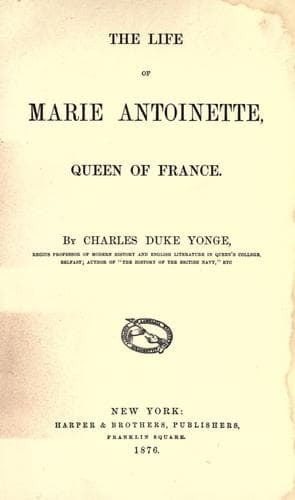
The Life of Marie Antoinette, Queen of FranceYonge, Charles Duke
History
The Life of Marie Antoinette, Queen of France
Yonge, Charles Duke
Marie Antoinette, Queen, consort of Louis XVI, King of France, 1755-1793
As, however, the cardinal's extravagance had left him with little means of
supplying her necessities, Madame La Mothe conceived the idea of swindling
Boehmer out of his necklace, and of making de Rohan an accomplice in the
fraud. The one thing which in the transaction is difficult to determine is
whether the cardinal was her willing and conscious assistant, or her dupe.
That his capacity was of the very lowest order was notorious, but he was a
man who had been bred in courts; he knew the manner in which princes
transacted their business, and in which queens signed their names. He had
long been acquainted with Marie Antoinette's figure and gestures and
voice; while, unhappily, there was nothing in his character which was
incompatible with his becoming an accomplice in any act of baseness.
What followed was a drama of surprises. It was with as much astonishment
as indignation that Marie Antoinette learned that Boehmer believed that
she had secretly bought the necklace, which openly and formally she had
refused, and that he was looking to her for the payment of its price. And
about a fortnight later it was like a thunder-clap that a summons came
upon the Cardinal de Rohan, who had just been performing mass before the
king and queen, to appear before them in Louis's private cabinet, and that
he found himself subjected to an examination by Louis himself, who
demanded of him with great indignation an explanation of the circumstances
that had led him to represent himself to Boehmer as authorized to buy a
necklace for the queen. Terrified and confused, he gave an explanation
which was half a confession; but which was too complicated to be
thoroughly intelligible. He was ordered to retire into the next room and
write out his statement. His written narrative proved more obscure than
his spoken words. In spite of his prayers that he might be spared the
degradation of being arrested while still clad in his pontifical habits,
he was at once sent to the Bastile. A day or two afterward Madame La Mothe
was apprehended in the provinces, and Louis directed that a prosecution
should be instantly commenced against all who had been concerned in the
transaction.
Public-domain text, read in full here on John Shaqi.
Reviews
Reviews
No reviews yet
Be the first to share your thoughts on this work.
Elsewhere in the archive
Join the Discussion
Join the discussion
Sign in to leave a comment or review.
Sign InorCreate an account