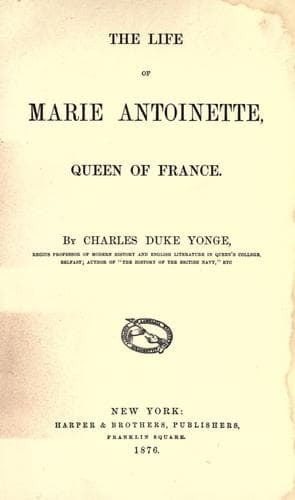
The Life of Marie Antoinette, Queen of FranceYonge, Charles Duke
History
The Life of Marie Antoinette, Queen of France
Yonge, Charles Duke
Marie Antoinette, Queen, consort of Louis XVI, King of France, 1755-1793
For the queen's name had been forged. The cardinal did not deny that he
had represented himself to Boehmer as employed by her for the purchase of
the jewel which, as he said, she secretly coveted, and for the payment of
its price by installments. But, as his justification, he produced a letter
desiring him to undertake the business, and signed "Marie Antoinette de
France." He declared that he had never suspected the genuineness of this
letter, though it was notorious that such an addition to their Christian
names was used by none but the sons and daughters of the reigning
sovereign, and never by a queen. And eventually his whole story was found
to be that Madame La Mothe had induced him to believe that she was in the
queen's confidence, and also that the queen coveted the necklace and was
resolved to obtain it; but that she was unable at once to pay for it; and
that, being desirous to make amends to the cardinal for the neglect with
which she had hitherto treated him, she had resolved on employing him to
make arrangements with Boehmer for the instant delivery of the ornament,
and for her payment of the price by installments.
This was strange enough to have excited the suspicions of most men. What
followed was stranger still. Not content with forging the queen's
handwriting, Madame La Mothe had even, if one may say so, forged the queen
herself. She had assured the cardinal that Marie Antoinette had consented
to grant him a secret interview; and at midnight, in the gardens of
Versailles, had introduced him to a woman of notoriously bad character
named Oliva, who in height resembled the queen, and who, in a conference
of half a minute, gave him a letter and a rose with the words, "You know
what this means." She had hardly uttered the words when Madame La Mothe
interrupted the pair with the warning the Countesses of Provence and
Artois were approaching. The mock queen retired in haste. The cardinal
pressed the rose to his heart; acted on the letter; and protested that he
had never doubted that he had seen the queen, and had been acting on her
commands in obtaining the necklace from Boehmer and delivering it to
Madame La Mothe, though he now acknowledged that he had been imposed upon,
and offered to pay the jeweler for his property.
Public-domain text, read in full here on John Shaqi.
Reviews
Reviews
No reviews yet
Be the first to share your thoughts on this work.
Elsewhere in the archive
Join the Discussion
Join the discussion
Sign in to leave a comment or review.
Sign InorCreate an account