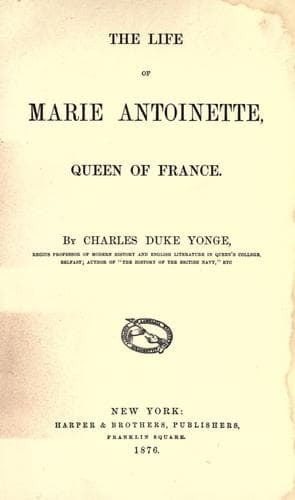
The Life of Marie Antoinette, Queen of FranceYonge, Charles Duke
History
The Life of Marie Antoinette, Queen of France
Yonge, Charles Duke
Marie Antoinette, Queen, consort of Louis XVI, King of France, 1755-1793
The Parliament of Paris, constantly endeavoring throughout its whole
history to encroach upon the royal prerogative, had always founded its
pretensions on its purity and disinterestedness. Since its
re-establishment at the beginning of the present reign, it had advanced
its claim to the possession of those virtues more loudly than ever; yet
now, in the very first case which came before it in which a noble of the
highest rank was concerned, it was made apparent not only that it was
wholly destitute of every quality which ought to belong to a judicial
bench, of a regard for truth and justice, and even of a knowledge of the
law; but that no one gave it credit for them, and that every one regarded
the decision to be given as one which would depend, not on the merits of
the case, but on the interest which the culprits might be able to make
with the judges.[8]
The trial took place in May of the following year. We need not enter into
its details; the denials, the admissions, the mutual recriminations of the
persons accused. In the fate of the La Mothes and Mademoiselle Oliva no
one professed to be concerned; but the friends of the cardinal were
numerous, rich, and powerful; and for months had been and still were
indefatigable in his cause. Some days before the trial, the attorney-
general had become aware that nearly the whole of the Parliament had been
gained by them; he even furnished the queen with a list of the names of
those judges who had promised their verdict beforehand, and of the means
by which they had been won over. And on the decisive morning the cardinal
and his friends made a theatrical display which was evidently intended to
overawe those members of the Parliament who were yet unconvinced, and to
enlist the sympathies of the public in general. He himself appeared at the
bar in a long violet cloak, the mourning robe of cardinals; and all the
passages leading to the hall of justice were lined by his partisans, also
in deep mourning; and they were not solely his own relations, the nobles
of the different branches of his family, the Soubises, the Rohans, the
Guimenées; but though, as princes of the blood, the Condés were nearly
allied to the king and queen, they also were not ashamed to swell the
company assembled, and to solicit the judges as they passed into the court
to disregard alike justice and their own oaths, and to acquit the
cardinal, whatever the evidence might be which had been, or was to be,
produced against him. They were only asking what they had already assured
themselves of obtaining. The queen's signature was indeed declared to be a
forgery, and the La Mothes, Mademoiselle Oliva, and a man named Retaux de
Villette, who had been the actual writer of the forged letters, were
convicted and sentenced to the punishment which the counsel for the crown
had demanded. But the cardinal was acquitted, as well as a notorious
juggler and impostor of the day, called Cagliostro, who had apparently
Public-domain text, read in full here on John Shaqi.
Reviews
Reviews
No reviews yet
Be the first to share your thoughts on this work.
Elsewhere in the archive
Join the Discussion
Join the discussion
Sign in to leave a comment or review.
Sign InorCreate an account