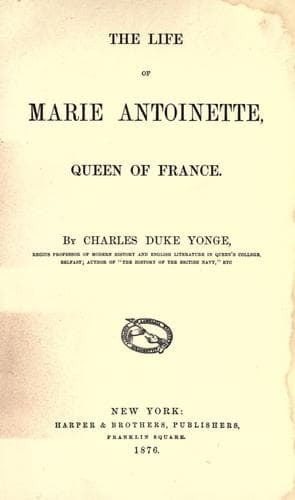
The Life of Marie Antoinette, Queen of FranceYonge, Charles Duke
History
The Life of Marie Antoinette, Queen of France
Yonge, Charles Duke
Marie Antoinette, Queen, consort of Louis XVI, King of France, 1755-1793
There were not wanting those who advised that this offer should be
accepted, and that the matter should be hushed up, rather than that a
prince of the Church should be publicly disgraced by a prosecution for
fraud. But Louis and Marie Antoinette both rightly judged that their duty
as sovereigns of the kingdom forbade them to compromise justice by
screening dishonesty. It was but two years before that a great noble, the
most eloquent of all French orators, had singled out Marie Antoinette's
love of justice as one of her most conspicuous, as it was one of her most
noble, qualities; and the words deserve especially to be remembered from
the melancholy contrast which his subsequent conduct presents to the
voluntary tribute which he now paid to her excellence. In 1783, the young
Count de Mirabeau, pleading for the restitution of his conjugal rights,
put the question to the judges at Aix before whom he was arguing, "Which
of you, if he desired to consecrate a living personification of justice,
and to embellish it with all the charms of beauty, would not set up the
august image of our queen?"
She and her husband might well have felt they were bound to act up to such
a eulogy. Some of their advisers also, and especially the Baron de
Breteuil and the Abbé de Yermond, fortified their decision with their
advice; being, in truth, greatly influenced by a reason which they forbore
to mention, namely, by their suspicion that the untiring malice of the
queen's enemies would not have failed to represent that the suppression of
the slightest particle of the truth could only have been dictated by a
guilty consciousness which felt that it could not bear the light; and that
the queen had forborne to bring the cardinal into court solely because she
knew that he was in a situation to prove facts which would deservedly
damage her reputation.
It is impossible to doubt that the resolution which was adopted was the
only one consistent with either propriety or common sense. However
plausible may be the arguments which in this or that case may be adduced
for concealment, the common instinct of mankind, which rarely errs in such
matters, always conceives a suspicion that it is dictated by secret and
discreditable motives; and that he who screens manifest guilt from
exposure and punishment makes himself an accomplice in the wrong-doing, if
he was not so before. But, though Louis judged rightly for his own and his
queen's character in bringing those who were guilty of forgery and robbery
to a public trial, the result inflicted an irremediable wound on one great
institution, furnishing an additional proof how incurably rotten the whole
system of the Government must have been, when corruption without shame or
disguise was allowed to sway the highest judicial tribunal in the country.
Public-domain text, read in full here on John Shaqi.
Reviews
Reviews
No reviews yet
Be the first to share your thoughts on this work.
Elsewhere in the archive
Join the Discussion
Join the discussion
Sign in to leave a comment or review.
Sign InorCreate an account